- BPM
- 175
- Key
- G Major
- Camelot
- 9B
Offenbach: Pariser Leben, Akt II: Briefarie (Rondo) "Sie denken, liebe Kleine, noch manchmal, wie ich meine" by Jacques Offenbach, Renate Holm, Willy Mattes, Munich Radio Orchestra Song Details
Jacques Offenbach, Renate Holm, Willy Mattes, Munich Radio Orchestra's ' "Offenbach: Pariser Leben, Akt II: Briefarie (Rondo) "Sie denken, liebe Kleine, noch manchmal, wie ich meine"" was released on its scheduled release date, 1983. The duration of This song is about 3 minutes long, at 3:24. Based on our data, This song appears to be safe for all ages and is not considered explicit. This track is about the average length of a typical track. There are a total of 41 in the song's album "Offenbach: Pariser Leben (Cologne Collection)". In this album, this song's track order is #18. Furthermore, we believe that the track originated from Germany. The popularity of Offenbach: Pariser Leben, Akt II: Briefarie (Rondo) "Sie denken, liebe Kleine, noch manchmal, wie ich meine" is currently not that popular right now. Since there is more of a neutral sound being played, this makes the track somewhat danceable.
BPM and Tempo
With Offenbach: Pariser Leben, Akt II: Briefarie (Rondo) "Sie denken, liebe Kleine, noch manchmal, wie ich meine" by Jacques Offenbach, Renate Holm, Willy Mattes, Munich Radio Orchestra having a BPM of 175 with a half-time of 88 BPM and a double-time of 350 BPM, we would consider this track to have a Vivace (lively and fast) tempo marking. Because of this, we believe that the song has an overall fast tempo. The time signature for this track is 4/4.
Music Key
This song is in the music key of G Major. Or for those who are familiar with the camelot wheel, this song has a camelot key of 9B. So, the perfect camelot match for 9B would be either 9B or 10A. While, 10B can give you a low energy boost. For moderate energy boost, you would use 6B and a high energy boost can either be 11B or 4B. Though, if you want a low energy drop, you should looking for songs with either a camelot key of 9A or 8B will give you a low energy drop, 12B would be a moderate one, and 7B or 2B would be a high energy drop. Lastly, 6A allows you to change the mood.
Want to find the BPM and music key for other songs? Check out our BPM and Key Finder page!
- Popularity
- 1%
- Loudness
- -13.464 dB
- Acousticness
- 92%
- Danceability
- 47%
- Energy
- 22%
- Instrumentalness
- 0%
- Liveness
- 25%
- Loudness
- 78%
- Speechiness
- 18%
- Valence
- 48%
Recommendations
| Track | Artist | Key | Energy | Camelot | BPM | ||
|---|---|---|---|---|---|---|---|
 | Vivaldi: The Four Seasons, Violin Concerto in F Minor, Op. 8 No. 4, RV 297 "Winter": I. Allegro non molto | Antonio Vivaldi, Nigel Kennedy, English Chamber Orchestra | F Minor | 2 | 4A | 159 BPM | |
 | Cavalleria rusticana: Act I: Intermezzo sinfonico | Pietro Mascagni, James Levine, National Philharmonic Orchestra | F Major | 1 | 7B | 87 BPM | |
 | Prokofiev: Suite No. 2 from Romeo and Juliet, Op. 64ter: I. The Montagues and Capulets (Excerpt) | Sergei Prokofiev, Philadelphia Orchestra, Riccardo Muti | A Minor | 3 | 8A | 108 BPM | |
 | Jazz Suite No. 2: VI. Waltz 2 | Dmitri Shostakovich, Russian State Symphony Orchestra, Dmitry Yablonsky | C Minor | 2 | 5A | 108 BPM | |
 | Schwanengesang, D.957: No. 4 Serenade | Franz Schubert, Eugene Ormandy, Philadelphia Orchestra | C Major | 0 | 8B | 91 BPM | |
 | Prince Igor: Polovtsian Dances (Version for Chorus) | Alexander Borodin, Kiev Chamber Choir, Ukraine National Radio Symphony Orchestra, Theodore Kuchar | A Major | 2 | 11B | 110 BPM | |
 | Rhapsody on a Theme of Paganini, Op. 43: Var. XVIII | Sergei Rachmaninoff, Leonard Pennario, Arthur Fiedler, Boston Pops Orchestra | A Minor | 1 | 8A | 129 BPM | |
 | J.S. Bach: J.S. Bach: Orchestral Suite No. 3 in D Major, BWV 1068: 2. Air | Johann Sebastian Bach, Orpheus Chamber Orchestra | D Major | 3 | 10B | 65 BPM | |
 | The Firebird (L'oiseau De Feu) - Suite (1919): Finale | Igor Stravinsky, Orchestre de l'Opéra National de Paris, Myung-Whun Chung | E Major | 2 | 12B | 78 BPM | |
 | In a Persian Market | Albert Ketèlbey, Ambrosian Opera Chorus, London Promenade Orchestra, Alexander Faris | D Minor | 1 | 7A | 108 BPM | |
 | Shéhérazade, Op. 35: III. The Young Prince and the Young Princess | Nikolai Rimsky-Korsakov, Sergej Galaktionov, Gianandrea Noseda, Filarmonica Teatro Regio Torino | G Major | 0 | 9B | 103 BPM | |
 | Dance of the Hours from Act III of "La Gioconda" | Amilcare Ponchielli, Philadelphia Orchestra, Eugene Ormandy | E Major | 1 | 12B | 130 BPM | |
 | Barcarolle: Belle nuit, ô nuit d’amour (Les Contes d’Hoffmann) | Jacques Offenbach, Fatma Said, Sascha Goetzel, Orchestre Philharmonique de Monte-Carlo | D Major | 1 | 10B | 129 BPM | |
 | Peer Gynt Suite No.1 op. 46 In the Hall of the Mountain King (Alla marciia e molto marcato) | Academy of St. Martin in the Fields | E Minor | 2 | 9A | 132 BPM | |
 | Strauss II, J: Frühlingsstimmen, Op. 410 | Johann Strauss II, Hallé, Bryden Thomson | B♭ Major | 0 | 6B | 103 BPM | |
 | Orpheus in the Underworld: Overture | Jacques Offenbach, Cincinnati Pops Orchestra, Erich Kunzel | G Major | 1 | 9B | 79 BPM | |
 | Suite for Variety Orchestra: Waltz 2 (Arr. for 12 Cellos) | Dmitri Shostakovich, Die 12 Cellisten der Berliner Philharmoniker | C Minor | 1 | 5A | 181 BPM | |
 | Gayane Suite No. 2: VI. Sabre Dance | Aram Khachaturian, St. Petersburg State Symphony Orchestra, Andre Anichanov | E♭ Major | 8 | 5B | 91 BPM | |
 | Sylvia: Act I: Valse lente | Léo Delibes, Razumovsky Symphony Orchestra, Andrew Mogrelia | A♭ Major | 0 | 4B | 111 BPM | |
 | Boccerini: Minuet In D | Richard Hartley | A Major | 1 | 11B | 200 BPM | |
 | Ruslan and Ludmila: Overture | Mikhail Glinka, The USSR Bolshoy Theatre Orchestra, Yevgeny Svetlanov | F Major | 3 | 7B | 81 BPM | |
 | Coppelia: Act I - Valse | Léo Delibes, Slovak Radio Symphony Orchestra, Andrew Mogrelia | E♭ Major | 0 | 5B | 89 BPM | |
 | Coppélia: Valse Lente | Léo Delibes, Orchestra of the Royal Opera House, Covent Garden | E♭ Major | 1 | 5B | 72 BPM | |
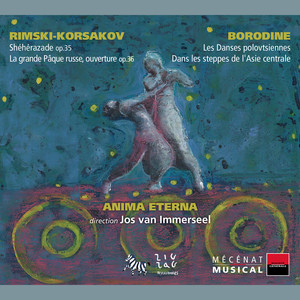 | Les danses polovtsiennes (Extraits de l'opéra Le Prince Igor): II. Danse des hommes | Alexander Borodin, Anima Eterna, Jos Van Immerseel | A Major | 0 | 11B | 87 BPM | |
 | 21 Hungarian Dances, WoO 1: Hungarian Dance No. 5 in F-Sharp Minor | Johannes Brahms, Seattle Symphony Orchestra, Gerard Schwarz | E Major | 1 | 12B | 102 BPM |
- ISRC
- DEA611400113
- Label
- L-M Records/RCA Records