- BPM
- 107
- Key
- A Major
- Camelot
- 11B
Suite in E Major, HWV 430: IV. Air - Double by George Frideric Handel, Ragna Schirmer Song Details
George Frideric Handel, Ragna Schirmer's ' "Suite in E Major, HWV 430: IV. Air - Double" was released on its scheduled release date, March 13, 2009. With this song being around four minutes long, at 4:17, the duration of this song is pretty average compared to other songs. This track is safe for children and doesn't appear to contain any foul language, since the "Explicit" tag was not present in this track. The track order of this song in George Frideric Handel, Ragna Schirmer's "Handel: Keyboard Suites" album is number 20 out of 71. On top of that, Germany appears to be the country where this track was created. In terms of popularity, Suite in E Major, HWV 430: IV. Air - Double is currently not that popular. Based on the vibe, this track doesn't seem to be that danceable, however its valence properties can make this some somewhat danceable.
BPM and Tempo
We consider the tempo marking of Suite in E Major, HWV 430: IV. Air - Double by George Frideric Handel, Ragna Schirmer to be Andante (at a walking pace) because the track has a tempo of 107 BPM, a half-time of 54BPM, and a double-time of 214 BPM. Based on that, the speed of the song's tempo is slow. The time signature for this track is 4/4.
Music Key
This song is in the music key of A Major. This also means that this song has a camelot key of 11B. So, the perfect camelot match for 11B would be either 11B or 12A. While, 12B can give you a low energy boost. For moderate energy boost, you would use 8B and a high energy boost can either be 1B or 6B. Though, if you want a low energy drop, you should looking for songs with either a camelot key of 11A or 10B will give you a low energy drop, 2B would be a moderate one, and 9B or 4B would be a high energy drop. Lastly, 8A allows you to change the mood.
Want to find the BPM and music key for other songs? Check out our BPM and Key Finder page!
- Popularity
- 4%
- Loudness
- -27.426 dB
- Acousticness
- 100%
- Danceability
- 35%
- Energy
- 11%
- Instrumentalness
- 90%
- Liveness
- 9%
- Loudness
- 54%
- Speechiness
- 4%
- Valence
- 51%
Recommendations
| Track | Artist | Key | Energy | Camelot | BPM | ||
|---|---|---|---|---|---|---|---|
 | Ouverture in D Major, "Darmstadt": Harlequinade | Georg Philipp Telemann, Cologne Chamber Orchestra, Helmut Müller-Brühl | D♭ Major | 1 | 3B | 174 BPM | |
 | Ständchen, S. 560 (Trans. from Schwanengesang No. 4, D. 957) | Franz Schubert, Franz Liszt, Khatia Buniatishvili | D Major | 0 | 10B | 67 BPM | |
 | Oboe Concerto in D Minor, S. Z799: III. Presto | Alessandro Marcello, Marcel Ponseele, Il Gardellino | D♭ Minor | 3 | 12A | 70 BPM | |
 | Adagio in G Minor "Albinoni's Adagio" | Remo Giazotto, Leon Spierer, David Bell, Berliner Philharmoniker, Herbert von Karajan | G Major | 0 | 9B | 62 BPM | |
 | Ancient Airs & Dances, Suite III, P. 172: I. Italiana (Anonymous) | Ottorino Respighi, Filarmonica della Scala, Riccardo Chailly | B♭ Major | 1 | 6B | 172 BPM | |
 | Haydn: Cello Concerto No. 1 in C Major, Hob. VIIb, 1: II. Adagio (Cadenza by Britten) | Franz Joseph Haydn, Mstislav Rostropovich, Academy of St. Martin in the Fields | F Major | 1 | 7B | 124 BPM | |
 | Le Bourgeois Gentilhomme - Comédie-Ballet, LWV 43: Ouverture | Jean-Baptiste Lully, Gustav Leonhardt, La Petite Bande, Sigiswald Kuijken | F♯ Minor | 1 | 11A | 106 BPM | |
 | Rameau: Les Boréades, Act 4: Entrée de Polymnie | Jean-Philippe Rameau, Gyorgy Vashegyi, Orfeo Orchestra | D Major | 2 | 10B | 122 BPM | |
 | Symphony No. 5 in B Flat Major, D. 485: II. Andante con moto | Franz Schubert, Chamber Orchestra of Europe, Claudio Abbado | E♭ Major | 1 | 5B | 81 BPM | |
 | Symphony in A Major, J-C 62: II. Andante e pianissimo | Giovanni Battista Sammartini, Aradia Ensemble, Kevin Mallon | A♭ Minor | 0 | 1A | 104 BPM | |
 | Water Music Suite No.1 In F, HWV 348: 1. Ouverture (Grave - Allegro) | George Frideric Handel, Simon Standage, Elizabeth Wilcock, The English Concert, Trevor Pinnock | E Major | 3 | 12B | 123 BPM | |
 | Ascanio in Alba, K. 111: Overture | Wolfgang Amadeus Mozart, Raphaël Boulay, Michael Chance, Jill Feldman, Rosa Mannion, Howard Milner, Lorna Windsor, Paris Sorbonne University Choir, Concerto Armonico Budapest, Jacques Grimbert | A♭ Major | 1 | 4B | 150 BPM | |
 | Triumphal March from Tancrede - Instrumental | André Campra, Richard Kapp, Philharmonia Virtuosi of New York | D Major | 3 | 10B | 149 BPM | |
 | Concerto For Oboe In D Minor - Presto | Tafelmusik Baroque Orchestra | D♭ Minor | 3 | 12A | 104 BPM | |
 | Chiome d'oro, SV 143 | Claudio Monteverdi, Sonia Wieder-Atherton | C Major | 1 | 8B | 119 BPM | |
 | Sinfonia for 2 Oboes in G Major (Arr. A. Camden): I. Allegro | Tomaso Albinoni, Anthony Camden, Alison Alty, London Virtuosi, John Georgiadis | D Major | 3 | 10B | 105 BPM | |
 | Oboe Concerto in C: 3. Siciliana | Domenico Cimarosa, Heinz Holliger, I Musici | A Minor | 1 | 8A | 84 BPM | |
 | Suite From Abdelzar: I. Rondeau | Henry Purcell, Tafelmusik Baroque Orchestra, Jeanne Lamon | D♭ Minor | 1 | 12A | 101 BPM | |
 | Eternal Source of Light Divine (From "Ode for the Birthday of Queen Anne, HWV 74") | George Frideric Handel, Wynton Marsalis, Kathleen Battle, John Nelson, Anthony Newman, John Feeney, Daire Fitzgerald, Orchestra of St. Luke's | C Major | 1 | 8B | 65 BPM | |
 | Gluck: Orfeo ed Euridice, Wq. 30, Act 2: Ballo d'eroi ed eroine negli Elisi - Andantino | Christoph Willibald Gluck, Philippe Jaroussky, Diego Fasolis, I Barocchisti | B Major | 0 | 1B | 89 BPM | |
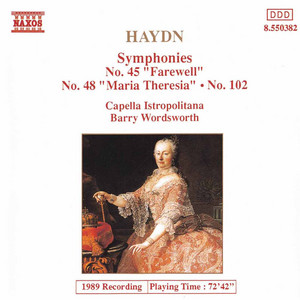 | Symphony No. 45 in F-Sharp Minor, Hob.I:45, "Farewell": I. Allegro assai | Joseph Haydn, Capella Istropolitana, Barry Wordsworth | F♯ Minor | 2 | 11A | 156 BPM | |
| Oboe Concerto in D Minor, S. Z799: I. Andante e spiccato | Alessandro Marcello, Marcel Ponseele, Il Gardellino | D Minor | 2 | 7A | 122 BPM | |
 | Stabat Mater: 5. Quis est homo | Giovanni Battista Pergolesi, Margaret Marshall, Lucia Valentini Terrani, London Symphony Orchestra, Claudio Abbado, Leslie Pearson | C Minor | 1 | 5A | 94 BPM | |
 | L'Allegro, Il Penseroso, ed il Moderato, HWV 55, Part III: "As steals the morn" | George Frideric Handel, Lucy Crowe, Mark Padmore, The English Concert, Andrew Manze | A Major | 1 | 11B | 84 BPM | |
 | Le carnaval des animaux, R. 125: Le cygne | Camille Saint-Saëns, Mischa Maisky, Orpheus Chamber Orchestra | C Major | 0 | 8B | 83 BPM |
- ISRC
- DES380905220
- Label
- L-M Records/RCA Records