- BPM
- 120
- Key
- G Minor
- Camelot
- 6A
Histoire Du Soldat (The Soldier's Tale) (Performed In English): Part I: V. The Soldier's March (Reprise) by Benjamin Soames, David Timson, Jonathan Keeble, Northern Chamber Orchestra, Igor Stravinsky Song Details
Benjamin Soames, David Timson, Jonathan Keeble, Northern Chamber Orchestra, Igor Stravinsky's ' "Histoire Du Soldat (The Soldier's Tale) (Performed In English): Part I: V. The Soldier's March (Reprise)" was released on its scheduled release date, January 19, 1999. With This song being less than two minutes long, at 1:46, we are fairly confident that this song is not explicit and is safe for all ages. Based on the duration of this song, this song duration is much smaller than the average song duration. There are a total of 33 in the song's album "Stravinsky: The Soldier' S Tale/ Dumbarton Oaks". In this album, this song's track order is #5. Furthermore, we believe that the track originated from Hong Kong. Based on our statistics, Histoire Du Soldat (The Soldier's Tale) (Performed In English): Part I: V. The Soldier's March (Reprise)'s popularity is unknown right now. The overall tone is very danceable, especially with its high energy, which produces more of a euphoric, cheerful, or happy vibe.
BPM and Tempo
With Histoire Du Soldat (The Soldier's Tale) (Performed In English): Part I: V. The Soldier's March (Reprise) by Benjamin Soames, David Timson, Jonathan Keeble, Northern Chamber Orchestra, Igor Stravinsky having a BPM of 120 with a half-time of 60 BPM and a double-time of 240 BPM, we would consider this track to have a Moderato (at a moderate speed) tempo marking. Because of this, we believe that the song has an overall fast tempo. Looking at the BPM of this song, this song might go great with walking. The time signature for this track is 4/4.
Music Key
G Minor is the music key of this track. Which also means that the camelot key for this song is 6A. So, the perfect camelot match for 6A would be either 6A or 5B. While, a low energy boost can consist of either 6B or 7A. For moderate energy boost, you would use 3A and a high energy boost can either be 8A or 1A. However, if you are looking for a low energy drop, finding a song with a camelot key of 5A would be a great choice. Where 9A would give you a moderate drop, and 4A or 11A would be a high energy drop. Lastly, 9B allows you to change the mood.
Want to find the BPM and music key for other songs? Check out our BPM and Key Finder page!
- Popularity
- 0%
- Loudness
- -22.484 dB
- Acousticness
- 88%
- Danceability
- 69%
- Energy
- 30%
- Instrumentalness
- 90%
- Liveness
- 11%
- Loudness
- 63%
- Speechiness
- 3%
- Valence
- 68%
Recommendations
| Track | Artist | Key | Energy | Camelot | BPM | ||
|---|---|---|---|---|---|---|---|
 | Martinu: Piano Quartet No. 1, H. 287: II. Adagio | Bohuslav Martinů, Domus | D Minor | 1 | 7A | 85 BPM | |
 | Quatuor pour hautbois, violon, violoncelle et piano, H.315: I. Moderato poco Allegro | Bohuslav Martinů, Philippe Tondre, Danae Dörken, Sarah Christian, Maximilian Hornung | F Minor | 4 | 4A | 104 BPM | |
 | Kapitel 1.1 - Feriengeschichten vom Franz | Christine Nöstlinger, Geschichten vom Franz | C Major | 7 | 8B | 38 BPM | |
 | Teil 13 - Folge 1: Der Frosch mit der Maske | Edgar Wallace - Filmedition, Edgar Wallace, Joachim Bartsch, Siegfried Lowitz, Joachim Fuchsberger, Ernst Fritz Fürbringer, Jochen Brockmann, Carl Lange, Fritz von Hardenberg | A Major | 7 | 11B | 88 BPM | |
 | Peter and the Wolf, Op. 67: X. The Bird Diverts the Wolf | Wiener Opernorchester | C Major | 2 | 8B | 156 BPM | |
 | Bartók: String Quartet No. 3 in C-Sharp Minor, Sz. 85: I. Prima parte. Moderato | Béla Bartók, Belcea Quartet | B♭ Minor | 1 | 3A | 89 BPM | |
 | Symphony No. 8: III. Volante | Mihkel Kerem, Royal Liverpool Philharmonic Orchestra, Andrew Manze | F Minor | 4 | 4A | 104 BPM | |
 | Five Pieces for String Quartet, WV 68: No. 3, Alla Czeca | Erwin Schulhoff, Leonkoro Quartet | F Minor | 4 | 4A | 104 BPM | |
 | Teil 1 - Folge 43: Professor van Dusen und der Leichenräuber | Professor van Dusen, Michael Koser, Friedrich W. Bauschulte, Klaus Herm, Heinz Giese, Michael Christian, Maren Kroymann, Herbert Weißbach, Heinz Spitzner, Klaus Jepsen, Susanne Lüpertz, Bernd Ludwig, Ingolf Gorges, Barbara Witte | E♭ Major | 4 | 5B | 65 BPM | |
 | Prairie Light, 3 Texas Watercolors of Georgia O'Keeffe: III. Starlight Night | Dan Welcher, Honolulu Symphony Orchestra, Donald Johanos | A Major | 0 | 11B | 120 BPM | |
 | Vae Tibi | Radoslaw Pallarz, Emily Körner, Philippe Tondre | A♭ Minor | 8 | 1A | 132 BPM | |
 | Serenade for String Orchestra in C Minor, Op. posth.: VI. Andante sostenuto | Max Bruch, George Hanson, Sinfonieorchester Wuppertal | E♭ Major | 0 | 5B | 87 BPM | |
 | Aurora Flame | Nuit | F♯ Minor | 8 | 11A | 129 BPM | |
 | Escenas | Gabriel Bouche Caro, Clare Monfredo, Eric Schultz | A Minor | 1 | 8A | 88 BPM | |
 | Kapitel 3.4 - Geschichten vom Franz | Geschichten vom Franz, Christine Nöstlinger | A♭ Major | 2 | 4B | 75 BPM | |
 | Die Kartoffeln | György Kurtág, Maria Husmann, Niek De Groot | F Minor | 4 | 4A | 104 BPM | |
 | Histoire du soldat (The Soldier's Tale) (Performed in English): Part II: VI. Narrator: The princess is lying on her bed | Igor Stravinsky, Jonathan Keeble, Benjamin Soames, David Timson, Northern Chamber Orchestra, Nicholas Ward | A♭ Major | 1 | 4B | 85 BPM | |
 | Woodwind Quintet, Op. 48: III. Andante pastorale | Marion Bauer, WindSync | F Minor | 4 | 4A | 104 BPM | |
 | Concerto for Orchestra, BB 123, Sz. 116: IV. Intermezzo interrotto | Béla Bartók, Toronto Symphony Orchestra, Gustavo Gimeno | F Minor | 4 | 4A | 104 BPM | |
 | Divertimento for Strings, BB 118 (Sz.113): II. Molto adagio | Béla Bartók, Orpheus Chamber Orchestra | B♭ Major | 1 | 6B | 105 BPM | |
 | Teil 16 - Moby Dick | Herman Melville, Eberhard Krug, Peter Schiff, Rolf Marnitz | D Major | 6 | 10B | 78 BPM | |
 | Stellar Voice | Astrid Voix | F Minor | 4 | 4A | 104 BPM | |
 | String Quartet No. 3 in D Major, Op. 34: III. Sostenuto. Like a Folk Tune | Erich Wolfgang Korngold, Calidore String Quartet | F Minor | 4 | 4A | 104 BPM | |
 | Hommage á Richard Strauss for Clarinet Solo | Béla Kovács | F Minor | 0 | 4A | 109 BPM | |
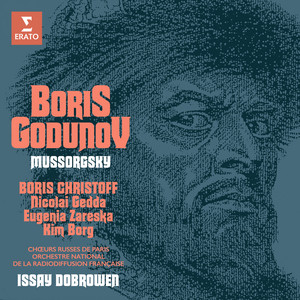 | Mussorgsky: Boris Godunov, Act 1: Drinking Song. "Kak vo gorode bylo vo Kazani" (Varlaam, Grigoriy, Misail) | Modest Mussorgsky, Issay Dobrowen, André Bielecki, Boris Christoff, Nicolai Gedda, Orchestre National Radiodiffusion Française | E♭ Major | 1 | 5B | 88 BPM |
- ISRC
- HKI199507505
- Label
- L-M Records/RCA Records