- BPM
- 101
- Key
- F♯ Minor
- Camelot
- 11A
Handel: Dixit Dominus, HWV 232: VI. Dominus a dextris tuis by George Frideric Handel, Jill Feldman/Dame Emma Kirkby/Emily Van Evera/Margaret Cable/Mary Nichols/Joseph Cornwell/Taverner Choir/Taverner Players/Andrew Parrott, Andrew Parrott, Taverner Players Song Details
"Handel: Dixit Dominus, HWV 232: VI. Dominus a dextris tuis" by George Frideric Handel, Jill Feldman/Dame Emma Kirkby/Emily Van Evera/Margaret Cable/Mary Nichols/Joseph Cornwell/Taverner Choir/Taverner Players/Andrew Parrott, Andrew Parrott, Taverner Players had its release date on January 1, 1989. This song is about six minutes long, preciously at 6:27, making this song fairly long compared to other songs. The track order of this song in George Frideric Handel, Andrew Parrott's "Handel - Carmelite Vespers" album is number 8 out of 54. On top of that, United Kingdom appears to be the country where this track was created. In terms of popularity, Handel: Dixit Dominus, HWV 232: VI. Dominus a dextris tuis is currently not that popular. In our opinion, the overall tone is not very danceable and projects negative sounds, such as being sad, depressed, or angry.
BPM and Tempo
We consider the tempo marking of Handel: Dixit Dominus, HWV 232: VI. Dominus a dextris tuis by George Frideric Handel, Jill Feldman/Dame Emma Kirkby/Emily Van Evera/Margaret Cable/Mary Nichols/Joseph Cornwell/Taverner Choir/Taverner Players/Andrew Parrott, Andrew Parrott, Taverner Players to be Andante (at a walking pace) because the track has a tempo of 101 BPM, a half-time of 50BPM, and a double-time of 202 BPM. Based on that, the speed of the song's tempo is slow. The time signature for this track is 3/4.
Music Key
This song is in the music key of F♯ Minor. This also means that this song has a camelot key of 11A. So, the perfect camelot match for 11A would be either 11A or 10B. While, a low energy boost can consist of either 11B or 12A. For moderate energy boost, you would use 8A and a high energy boost can either be 1A or 6A. However, if you are looking for a low energy drop, finding a song with a camelot key of 10A would be a great choice. Where 2A would give you a moderate drop, and 9A or 4A would be a high energy drop. Lastly, 2B allows you to change the mood.
Want to find the BPM and music key for other songs? Check out our BPM and Key Finder page!
- Popularity
- 2%
- Loudness
- -26.855 dB
- Acousticness
- 81%
- Danceability
- 19%
- Energy
- 4%
- Instrumentalness
- 0%
- Liveness
- 15%
- Loudness
- 55%
- Speechiness
- 5%
- Valence
- 4%
Recommendations
| Track | Artist | Key | Energy | Camelot | BPM | ||
|---|---|---|---|---|---|---|---|
 | Concerto Grosso in D Major, Op. 1, No. 5: III. Largo | Pietro Locatelli, Capella Istropolitana, Jaroslav Krcek | G Major | 1 | 9B | 144 BPM | |
 | Concerto Grosso In D Major, Op. 6, No. 1 : V. Largo | Arcangelo Corelli, Quido Holbling, Daniela Ruso, Ludovit Kanta, Anna Holbling, Capella Istropolitana | B Minor | 1 | 10A | 87 BPM | |
 | Concerto Grosso No. 3 in F Major: IV. Largo | Alessandro Scarlatti, Capella Istropolitana, Jaroslav Krcek | D Minor | 1 | 7A | 168 BPM | |
 | Flute Concerto in A Minor, QV 5:238: I. Allegretto | Johann Joachim Quantz, Mary Oleskiewicz, Concerto Armonico Budapest, Miklós Spányi | G Minor | 2 | 6A | 143 BPM | |
 | Adagio in F, H.XVII No. 9 | Joseph Haydn, Alfred Brendel | F Major | 0 | 7B | 71 BPM | |
 | Sonata in D Major, No. 1: IV. Adagio | Arcangelo Corelli, Lucy van Dael, Bob van Asperen | B♭ Minor | 1 | 3A | 96 BPM | |
 | Symphony in A Major, J-C 62: II. Andante e pianissimo | Giovanni Battista Sammartini, Aradia Ensemble, Kevin Mallon | A♭ Minor | 0 | 1A | 104 BPM | |
 | Rusalka, Op. 114: Song to the Moon (Arranged for Violin & Orchestra by Joshua Bell) | Antonín Dvořák, Joshua Bell, Michael Stern, Orchestra of St. Luke's | F♯ Major | 1 | 2B | 137 BPM | |
 | String Quintet in E Major, G. 275: III. Minuetto - Trio | Luigi Boccherini, Cuarteto Casals, Eckart Runge | A Major | 0 | 11B | 127 BPM | |
 | Fauré: Pavane, Op. 50 (Instrumental Version) | Gabriel Fauré, Sir Neville Marriner, Academy of St. Martin in the Fields | F♯ Minor | 1 | 11A | 70 BPM | |
 | Concerto for Two Violas in G Major, TWV 52:G3: Concerto for Two Violas in G Major, TWV 52:G3: I. Avec douceur | Georg Philipp Telemann, Antoine Tamestit, Sabine Fehlandt, Akademie für Alte Musik Berlin, Bernhard Forck | F♯ Major | 1 | 2B | 112 BPM | |
 | Violin Concerto in D Minor, Op. 7 No. 1: I. Allegro | Jean-Marie Leclair, Fabio Biondi, Europa Galante | D♭ Minor | 2 | 12A | 88 BPM | |
 | Magnificat (Chorus) | Carl Philipp Emanuel Bach, Elisabeth Scholl, Ruth Sandhoff, Andreas Karasiak, Gotthold Schwarz, Dresdner Kammerchor, La Stagione Frankfurt, Michael Schneider | D♭ Major | 2 | 3B | 130 BPM | |
 | Piano Concerto in G Major, M. 83: II. Adagio assai | Maurice Ravel, Krystian Zimerman, Cleveland Orchestra, Pierre Boulez | E Major | 0 | 12B | 74 BPM | |
 | Oboe Concerto in D Minor, Op. 9 No. 2: II. Adagio | Tomaso Albinoni, David Reichenberg, The English Concert, Trevor Pinnock | A Major | 1 | 11B | 68 BPM | |
 | Serenade for Winds No. 10 in B-Flat Major, K. 361/370a "Gran Partita": III. Adagio | Wolfgang Amadeus Mozart, Sir Colin Davis, Winds of the Bavarian Radio Symphony Orchestra | B Major | 4 | 1B | 157 BPM | |
 | Musiche sacre: No. 23, Canzon à 3 | Francesco Cavalli, London Baroque | A♭ Minor | 1 | 1A | 122 BPM | |
 | Trumpet Sonata in D Major, Z. 850: I. Allegro | Henry Purcell, Ede Inhoff, Hungarian State Opera Chamber Orchestra | E♭ Minor | 0 | 2A | 83 BPM | |
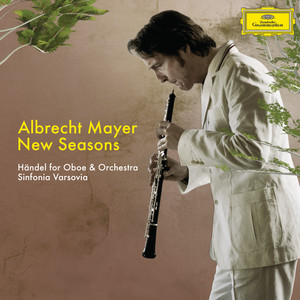 | Concerto for Oboe d'amore, Strings and B.c. "Verdi prati": Allegro ("Tornami a vagheggiar" from Opera 'Alcina', HWV 34) | George Frideric Handel, Albrecht Mayer, Sinfonia Varsovia, Jakub Haufa, Monika Razynska | A Major | 2 | 11B | 103 BPM | |
 | Orfeo ed Euridice: Melody (Arr. G. Sgambati) | Christoph Willibald Gluck, Jura Margulis | D Minor | 0 | 7A | 73 BPM | |
 | Sonata in C Major, Kk. 159 | Domenico Scarlatti, Daniel Barenboim | C Major | 1 | 8B | 177 BPM | |
 | Mozart: Divertimento in D Major, K. 136 "Salzburg Symphony No. 1": II. Andante | Wolfgang Amadeus Mozart, Amsterdam Baroque Orchestra, Ton Koopman | B Minor | 1 | 10A | 105 BPM | |
 | Sinfonia In D Major, Wq. 183/1, H. 663 : II. Largo | Carl Philipp Emanuel Bach, Salzburg Chamber Philharmonic Orchestra | F Major | 0 | 7B | 133 BPM | |
 | Atys, LWV 53: Ouverture | Jean-Baptiste Lully, Leonardo García-Alarcón, Cappella Mediterranea | F Minor | 3 | 4A | 131 BPM | |
 | Ode for St. Cecilia's Day, HWV 76: Air: What passion cannot Music raise | George Frideric Handel, Dorothee Mields, Mark Wilde, Alsfelder Vocal Ensemble, Concerto Polacco, Wolfgang Helbich | A♭ Minor | 0 | 1A | 96 BPM |
- ISRC
- GBAYC8701570
- Label
- L-M Records/RCA Records