- BPM
- 88
- Key
- B♭ Major
- Camelot
- 6B
II. Fugue by Johann Sebastian Bach, Rudolf Müller Song Details
"II. Fugue" by Johann Sebastian Bach, Rudolf Müller had its release date on February 20, 2014. With this song being around four minutes long, at 4:26, the duration of this song is pretty average compared to other songs. This track is safe for children and doesn't appear to contain any foul language, since the "Explicit" tag was not present in this track. The track order of this song in Rudolf Müller's "Great European Organs, Vol. 95: Monastery Church, Mariannhill" album is number 2 out of 13. On top of that, United Kingdom appears to be the country where this track was created. II. Fugue is unknown right now. In our opinion, the overall tone is not very danceable and projects negative sounds, such as being sad, depressed, or angry.
BPM and Tempo
We consider the tempo marking of II. Fugue by Johann Sebastian Bach, Rudolf Müller to be Andante (at a walking pace) because the track has a tempo of 88 BPM, a half-time of 44BPM, and a double-time of 176 BPM. Based on that, the speed of the song's tempo is slow. Activities such as, yoga or pilates, can go well with this song. The time signature for this track is 4/4.
Music Key
This song is in the music key of B♭ Major. This also means that this song has a camelot key of 6B. So, the perfect camelot match for 6B would be either 6B or 7A. While, 7B can give you a low energy boost. For moderate energy boost, you would use 3B and a high energy boost can either be 8B or 1B. Though, if you want a low energy drop, you should looking for songs with either a camelot key of 6A or 5B will give you a low energy drop, 9B would be a moderate one, and 4B or 11B would be a high energy drop. Lastly, 3A allows you to change the mood.
Want to find the BPM and music key for other songs? Check out our BPM and Key Finder page!
- Popularity
- 0%
- Loudness
- -20.174 dB
- Acousticness
- 79%
- Danceability
- 10%
- Energy
- 9%
- Instrumentalness
- 86%
- Liveness
- 10%
- Loudness
- 66%
- Speechiness
- 4%
- Valence
- 4%
Recommendations
| Track | Artist | Key | Energy | Camelot | BPM | ||
|---|---|---|---|---|---|---|---|
 | Concerto Grosso in D Major, Op. 6 No. 4: II. Allegro | Arcangelo Corelli, Jordi Savall, Le Concert Des Nations | D♭ Major | 3 | 3B | 133 BPM | |
 | Waltz in G-Flat Major, D. 1/14 "Kupelwieser-Walzer" | Franz Schubert, Michael Endres | D Minor | 1 | 7A | 113 BPM | |
 | Nocturne No. 2 in C Minor, H. 25 | John Field, Benjamin Frith | C Minor | 0 | 5A | 98 BPM | |
 | Keyboard Sonata in B Minor, Kk. 87 | Domenico Scarlatti, Ivo Pogorelich | B Minor | 0 | 10A | 147 BPM | |
 | Minuet in G Minor, HWV 434 No. 4 (Transc. W. Kempff) | George Frideric Handel, Roberto Cominati | G Minor | 0 | 6A | 66 BPM | |
 | Fantasie g-Moll "duobus subjectis" BWV 917 | Inge Rosar | A Minor | 3 | 8A | 64 BPM | |
 | Méditation from Thaïs | Jules Massenet, Nicola Benedetti, London Symphony Orchestra, Daniel Harding | E Minor | 1 | 9A | 89 BPM | |
 | Ständchen in D Minor (After Schubert), S. 560 | Franz Liszt, Lise de la Salle | D Major | 0 | 10B | 76 BPM | |
 | Orchestral Suite No. 4 in D Major, BWV 1069: I. Ouverture | Johann Sebastian Bach, Ludwig Güttler, Matthias Schmutzler, Roland Rudolph, Thomas Käppler, Andreas Lorenz, Manfred Krause, Günter Klier, Virtuosi Saxoniae | A Major | 1 | 11B | 77 BPM | |
 | Wachet auf, ruft uns die Stimme, BWV 645 | Yo-Yo Ma, Ton Koopman, Amsterdam Baroque Orchestra | D Major | 0 | 10B | 79 BPM | |
 | Oboe Concerto in C Major, Op. 9, No. 5: II. Adagio (non troppo) | Tomaso Albinoni, Anthony Camden, London Virtuosi, John Georgiadis | A Minor | 1 | 8A | 79 BPM | |
 | Herz und Mund und Tat und Leben, BWV 147: Herz und Mund und Tat und Leben (Chorus) | Johann Sebastian Bach, Judith Spiesser, Annekathrin Laabs, Robert Sellier, Timo Janzen, Arcis-Vocalisten Munich, L'Arpa Festante Baroque Orchestra, Thomas Gropper | D♭ Minor | 1 | 12A | 127 BPM | |
 | Christmas Oratorio, BWV 248/1: Bereite dich, Zion (Alto) | Johann Sebastian Bach, Christian Friedrich Henrici, Marianne Beate Kielland, Alfredo Bernardini, Barokkanerne | F Major | 2 | 7B | 81 BPM | |
 | Bach, JS : Well-Tempered Clavier Book 1 : Prelude No.8 in E flat minor BWV853 | Daniel Barenboim | A♭ Minor | 0 | 1A | 70 BPM | |
 | 5 Pieces for Violin and Piano: I. Elegia. Andante larghetto | Valentin Silvestrov, Duo Gazzana | E♭ Major | 0 | 5B | 74 BPM | |
 | Concerto For 2 Keyboards In C Major, BWV 1061: III. Vivace | Cologne Chamber Orchestra, Christoph Anselm Noll, Gerald Hambitzer, Johann Sebastian Bach | A Minor | 3 | 8A | 98 BPM | |
 | Kinderszenen | Robert Schumann, Ivan Moravec | F Major | 0 | 7B | 131 BPM | |
 | Preghiera (Arr. by Fritz Kreisler from Piano Concerto No. 2 in C Minor, Op. 18, 2nd Movement) | Sergei Rachmaninoff, Gidon Kremer, Daniil Trifonov | C Major | 1 | 8B | 104 BPM | |
 | Sonata for two pianos KV448 in D Major, Andante | Wolfgang Amadeus Mozart, Alfred Brendel, Walter Klien, Paul Angerer, Orchester der Wiener Staatsoper | G Major | 1 | 9B | 118 BPM | |
 | Chromatic Fantasia And Fugue In D Minor, BWV 903 : Fugue | Janos Sebestyen, Johann Sebastian Bach | D Minor | 3 | 7A | 88 BPM | |
 | Sicilienne, BWV 1031 | Valentina Lisitsa | D Minor | 2 | 7A | 73 BPM | |
 | Bach Orchestral Suite No.2 in B Minor, BWV 1076: I. Ouverture | London Conchord Ensemble, Florian Uhlig | B Minor | 3 | 10A | 121 BPM | |
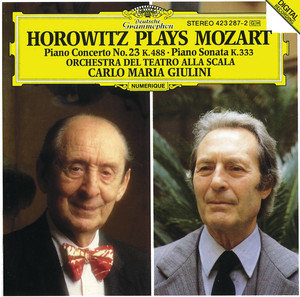 | Piano Concerto No. 23 in A Major, K. 488: I. Allegro (Cadenza by Busoni) | Wolfgang Amadeus Mozart, Vladimir Horowitz, Orchestra Del Teatro Alla Scala, Milano, Carlo Maria Giulini | A Major | 1 | 11B | 140 BPM | |
 | Prelude No. 3 in C# Major from The Well-Tempered Clavier Book I, BWV 848 | Brad Mehldau | D♭ Major | 3 | 3B | 129 BPM | |
 | J.S. Bach: J.S. Bach: Orchestral Suite No. 3 in D Major, BWV 1068: 2. Air | Johann Sebastian Bach, Orpheus Chamber Orchestra | D Major | 3 | 10B | 65 BPM |
- ISRC
- GBXUX1412702
- Label
- L-M Records/RCA Records