- BPM
- 75
- Key
- F♯ Major
- Camelot
- 2B
Francesca da Rimini, Op. 4, Act IV, Scene Tableau II: Vieni, vieni, vieni, Francesca! (Paolo, Francesca, Gianciotto) by Riccardo Zandonai, Wiener Symphoniker, Fabio Luisi, Elena Filipova, Frederic Kalt, Philippe Roillon Song Details
Riccardo Zandonai, Wiener Symphoniker, Fabio Luisi, Elena Filipova, Frederic Kalt, Philippe Roillon's 'Francesca da Rimini, Op. 4, Act IV, Scene Tableau II: Vieni, vieni, vieni, Francesca! (Paolo, Francesca, Gianciotto)' had a release date set for 1994. With this song being around four minutes long, at 3:40, the duration of this song is pretty average compared to other songs. This track is safe for children and doesn't appear to contain any foul language, since the "Explicit" tag was not present in this track. This song is part of Zandonai: Francesca da Rimini by Riccardo Zandonai, Elena Filipova, Fabio Luisi, Wiener Symphoniker. The song's track number on the album is #17 out of 47 tracks. Based on our data, Austria was the country where this track was produced or recorded. Francesca da Rimini, Op. 4, Act IV, Scene Tableau II: Vieni, vieni, vieni, Francesca! (Paolo, Francesca, Gianciotto) is unknown right now. In our opinion, the overall tone is not very danceable and projects negative sounds, such as being sad, depressed, or angry.
BPM and Tempo
Since Francesca da Rimini, Op. 4, Act IV, Scene Tableau II: Vieni, vieni, vieni, Francesca! (Paolo, Francesca, Gianciotto) by Riccardo Zandonai, Wiener Symphoniker, Fabio Luisi, Elena Filipova, Frederic Kalt, Philippe Roillon has a tempo of 75 beats per a minute, the tempo markings of this song would be Adagio (slowly with great expression). With Francesca da Rimini, Op. 4, Act IV, Scene Tableau II: Vieni, vieni, vieni, Francesca! (Paolo, Francesca, Gianciotto) being at 75 BPM, the half-time would be 38 BPM with a double-time of 150 BPM.In addition, we consider the tempo speed to be pretty slow for this song. The time signature for this track is 3/4.
Music Key
This song has a musical key of F♯ Major. Or for those who are familiar with the camelot wheel, this song has a camelot key of 2B. So, the perfect camelot match for 2B would be either 2B or 3A. While, 3B can give you a low energy boost. For moderate energy boost, you would use 11B and a high energy boost can either be 4B or 9B. Though, if you want a low energy drop, you should looking for songs with either a camelot key of 2A or 1B will give you a low energy drop, 5B would be a moderate one, and 12B or 7B would be a high energy drop. Lastly, 11A allows you to change the mood.
Want to find the BPM and music key for other songs? Check out our BPM and Key Finder page!
- Popularity
- 0%
- Loudness
- -20.03 dB
- Acousticness
- 98%
- Danceability
- 29%
- Energy
- 25%
- Instrumentalness
- 0%
- Liveness
- 16%
- Loudness
- 67%
- Speechiness
- 4%
- Valence
- 30%
Recommendations
| Track | Artist | Key | Energy | Camelot | BPM | ||
|---|---|---|---|---|---|---|---|
 | Cendrillon: Faites-vous très belles | Jules Massenet, Philharmonia Orchestra, Julius Rudel | B♭ Major | 1 | 6B | 115 BPM | |
 | Madama Butterfly, SC 74: Che giova? ... Io so che alle sue pene | Giacomo Puccini, Jonathan Tetelman, Rihab Chaieb, Önay Köse, PKF – Prague Philharmonia, Carlo Rizzi | F♯ Major | 4 | 2B | 94 BPM | |
 | Francesca da Rimini, Act IV: O Biancofiore, piccola tu sei! (Live) | Riccardo Zandonai, Magda Olivero, Orchestra Del Teatro Alla Scala, Milano, Anna Maria Rota, Gianandrea Gavazzeni | E♭ Major | 5 | 5B | 140 BPM | |
 | Carmen / Act 2: Quintette: "Nous avons en tête une affaire!" | Georges Bizet, Christine Barbaux, Jane Berbié, Agnes Baltsa, Heinz Zednik, Gino Quilico, Berliner Philharmoniker, Herbert von Karajan | F Minor | 1 | 4A | 72 BPM | |
 | Francesca da Rimini / Act 3: Ah, la parola che i miei occhi incontrano...E Galeotto | Riccardo Zandonai, Mario del Monaco, Magda Olivero, Monte-Carlo Philharmonic Orchestra, Nicola Rescigno | D♭ Minor | 2 | 12A | 66 BPM | |
 | L'elisir d'amore / Act 1: "Signor sargente" | Gaetano Donizetti, Maria Casula, Dominic Cossa, Luciano Pavarotti, Dame Joan Sutherland, Ambrosian Opera Chorus, English Chamber Orchestra, Richard Bonynge | E♭ Major | 3 | 5B | 84 BPM | |
 | Gounod: Faust, Act 1: Récitatif. "Mais ce Dieu, que peut-il pour moi?" (Faust) | Charles Gounod, Michel Plasson, Richard Leech, Orchestre Du Capitole De Toulouse | A Minor | 1 | 8A | 94 BPM | |
| Gounod: Faust, Act 1: "Ah ! Paresseuse fille qui sommeille encor !" - Chœur des laboureurs. "Aux champs l'aurore nous rappelle" (Chœur, Faust) | Charles Gounod, Michel Plasson, Chœur de l'Armée française, Choeur Du Capitole De Toulouse, Richard Leech, Orchestre Du Capitole De Toulouse | A Minor | 1 | 8A | 94 BPM | |
 | Donizetti: Don Pasquale, Act 2: "Io? Io?" (Pasquale, Ernesto, Malatesta, Norina) | Gaetano Donizetti, Riccardo Muti, Gösta Winbergh, Leo Nucci, Mirella Freni, Sesto Bruscantini, Philharmonia Orchestra | D Major | 4 | 10B | 139 BPM | |
 | Francesca da Rimini, Op. 4, Act III, Scene 3: Smaragdi, non torna? (Francesca, Smaragdi) | Riccardo Zandonai, Wiener Symphoniker, Fabio Luisi, Elena Filipova, Lorena Espina | A Major | 0 | 11B | 70 BPM | |
| Francesca da Rimini, Op. 4, Act II, Scene 4: Questo cimento è il giudizio di Dio (Francesca, Paolo, Chorus) | Riccardo Zandonai, Wiener Symphoniker, Fabio Luisi, Elena Filipova, Frederic Kalt, Kammerchor Sofia | D♭ Major | 2 | 3B | 123 BPM | |
 | La Gioconda / Act 2: Pescator, affonda l'esca | Amilcare Ponchielli, Sherrill Milnes, Finchley Children's Music Group, The London Opera Chorus, National Philharmonic Orchestra, Bruno Bartoletti | C Minor | 2 | 5A | 92 BPM | |
| Il tabarro, SC 85: O Luigi! Luigi! ... Dimmi, perché gli hai chiesto | Giacomo Puccini, Jonathan Tetelman, Vida Miknevičiūtė, Önay Köse, PKF – Prague Philharmonia, Carlo Rizzi | F♯ Minor | 2 | 11A | 83 BPM | |
 | Ponchielli : La Gioconda : Act 2 "Cielo e mar" [Enzo] | Amilcare Ponchielli, Plácido Domingo, Nello Santi, Orchester der Deutschen Oper Berlin | E♭ Major | 3 | 5B | 146 BPM | |
 | Wagner: Lohengrin, Act 2: "Welch ein Geheimnis muss der Held bewahren?" (Henry, Elsa, Chorus) | Richard Wagner, Daniel Barenboim, Chor der Deutschen Staatsoper Berlin, Emily Magee, René Pape, Staatskapelle Berlin | F Major | 3 | 7B | 78 BPM | |
 | La traviata / Act 2: "Alfredo?" "Per Parigi or or partiva" | Giuseppe Verdi, Cheryl Studer, Sondra Kelly, John Hanriot, Juan Pons, Metropolitan Opera Orchestra, James Levine | C Major | 0 | 8B | 171 BPM | |
 | Lucia di Lammermoor / Act 3: Ohimè! Sorge il tremendo fantasma | Gaetano Donizetti, Nadine Sierra, Orchestra Sinfonica Nazionale della Rai, Riccardo Frizza | B Major | 3 | 1B | 86 BPM | |
| Francesca da Rimini, Op. 4, Act III, Scene 11: Dama, abbiatene pietà (Paolo, Francesca) | Riccardo Zandonai, Wiener Symphoniker, Fabio Luisi, Elena Filipova, Frederic Kalt | D♭ Minor | 1 | 12A | 82 BPM | |
 | Tosca, Act I: Un tal baccano in chiesa! Bel rispetto! | Giacomo Puccini, Matteo Macchioni, Ludovic Tezier, Davide Giangregorio, Orchestra dell'Accademia Nazionale di Santa Cecilia, Daniel Harding | E♭ Minor | 3 | 2A | 135 BPM | |
| Carmen / Act 1: Votre mère avec moi sortait de la chapelle | Georges Bizet, Katia Ricciarelli, José Carreras, Berliner Philharmoniker, Herbert von Karajan | B♭ Major | 0 | 6B | 129 BPM | |
 | "Nera Nerella, il cuore è un bambolino" - For Voice, Strings and Harp | Riccardo Zandonai, Spettro Armonico Chamber Orchestra, Simone Zuccatti, Francesca Tirale, Maria Letizia Grosselli | E Major | 7 | 12B | 104 BPM | |
 | Simon Boccanegra: Prologo: Che dicesti (Paolo, Pietro, Simone, Coro) | Giuseppe Verdi, Mattia Olivieri, Andrea Pellegrini, Ludovic Tezier, Coro del Teatro di San Carlo di Napoli, Michele Spotti, Orchestra del Teatro San Carlo di Napoli | C Major | 1 | 8B | 81 BPM | |
 | La forza del destino, Act I: Buona notte, mia figlia (Il Marchese di Calatrava/Donna Leonora) | Giuseppe Verdi, Giorgio Surian, Mirella Freni, Orchestra Del Teatro Alla Scala, Milano, Riccardo Muti, Orchestra Del Teatro Alla Scala Di Milan | A Major | 1 | 11B | 85 BPM | |
 | Das Lied von der Erde: VId. Der Abschied. Schwer | Gustav Mahler, Les Siècles, François-Xavier Roth, Marie-Nicole Lemieux | C Major | 1 | 8B | 81 BPM | |
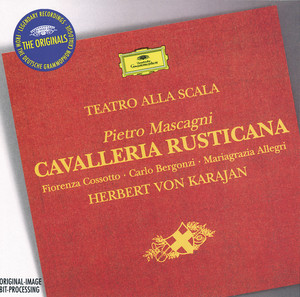 | Cavalleria rusticana: Tu qui, Santuzza? – Fior la giaggolo | Pietro Mascagni, Fiorenza Cossotto, Carlo Bergonzi, Orchestra Del Teatro Alla Scala, Milano, Herbert von Karajan | D♭ Major | 1 | 3B | 164 BPM |
- ISRC
- ATMA40502223
- Label
- L-M Records/RCA Records