- BPM
- 120
- Key
- A Minor
- Camelot
- 8A
Für Elise by Essential Band Song Details
Essential Band's 'Für Elise' had a release date set for June 12, 2020. With this song being around four minutes long, at 3:49, the duration of this song is pretty average compared to other songs. This track is safe for children and doesn't appear to contain any foul language, since the "Explicit" tag was not present in this track. The song is number 2 out of 15 in Baby's Essential Lullabies by Essential Band. Going off of the ISRC code of this track, we detected that the origin of this track is from South Africa. Based on our statistics, Für Elise's popularity is unknown right now. Although the tone can be danceable to some, this track does projects more of a negative sound rather than a postive one.
BPM and Tempo
The tempo marking of Für Elise by Essential Band is Moderato (at a moderate speed), since this song has a tempo of 120 BPM. With that information, we can conclude that the song has a fast tempo. This song can go great with walking. The time signature for this track is 4/4.
Music Key
A Minor is the music key of this track. Because this track belongs in the A Minor key, the camelot key is 8A. So, the perfect camelot match for 8A would be either 8A or 7B. While, a low energy boost can consist of either 8B or 9A. For moderate energy boost, you would use 5A and a high energy boost can either be 10A or 3A. However, if you are looking for a low energy drop, finding a song with a camelot key of 7A would be a great choice. Where 11A would give you a moderate drop, and 6A or 1A would be a high energy drop. Lastly, 11B allows you to change the mood.
Want to find the BPM and music key for other songs? Check out our BPM and Key Finder page!
- Popularity
- 0%
- Loudness
- -8.121 dB
- Acousticness
- 93%
- Danceability
- 45%
- Energy
- 42%
- Instrumentalness
- 64%
- Liveness
- 39%
- Loudness
- 86%
- Speechiness
- 4%
- Valence
- 23%
Recommendations
| Track | Artist | Key | Energy | Camelot | BPM | ||
|---|---|---|---|---|---|---|---|
 | Carmen, Opera Suite No. 1: III. Intermezzo, Act 3 | London Festival Orchestra, Alfred Scholz | E♭ Major | 0 | 5B | 134 BPM | |
 | Tritsch Tratsch - Galopp Polka, Op. 214 | Orchestra of the Viennese Volksoper & Alfred Scholz | A Major | 2 | 11B | 80 BPM | |
 | The four seasons, Winter, Op. 8/4: II. Largo | Jörg Faerber, Susanne Lautenbacher, Württemberg Chamber Orchestra | B♭ Major | 1 | 6B | 123 BPM | |
 | Harp Concerto in B flat, Op. 4, No. 6, HWV 294 - Transcr. from Organ Concerto No. 6, HWV 294 by composer: 1. Andante allegro | George Frideric Handel, Ursula Holliger, André Pepin, Jean-Claude Hermanjat, I Musici | A Major | 2 | 11B | 97 BPM | |
 | The Four Seasons (Le Quattro Stagioni): Concerto No. 2 in G Minor, Op. 8, RV 315, "Summer": III. Presto | Antonio Vivaldi, Chamber Orchestra Merck, Zdeněk Simane | G Minor | 5 | 6A | 140 BPM | |
 | Quintetto No. 4 in Re Maggiore "Fandango" per Corda e Chitarra, G. 448: Pastorale | Luigi Boccherini, Jordi Savall, Rolf Lislevand, Le Concert Des Nations | A Major | 0 | 11B | 128 BPM | |
 | Klavier-Quintett, A-Dur, op. 114, D 667: Andante | Caspar Da Salo Quintett | C Major | 0 | 8B | 104 BPM | |
 | No. 4, Ständchen | Franz Schubert, Budapest Strings, Béla Bánfalvi | D Major | 0 | 10B | 171 BPM | |
 | Binge: Elizabethan Serenade, "The Man in the Street" | Ronald Binge, Reginald Kilbey, Studio 2 Symphony Orchestra | F Major | 1 | 7B | 149 BPM | |
 | Romance for Violin & Orchestra No.2 F Major Op.50 | Alberto Lizzio, Philharmonica Slavonica, Ivan Czerkov | F Major | 1 | 7B | 98 BPM | |
 | Roses from the South Waltz, Op. 388 | Johann Strauss II, Vienna Volksoper Orchestra, Peter Falk | F Major | 1 | 7B | 190 BPM | |
 | Songs Without Words, Op. 62: No. 6 in A Major: Molto allegro vivace "Fruhlinglied" (Spring Melody) | Ilmar Lapinsch, Latvian Philharmonic Chamber Orchestra | A Major | 3 | 11B | 89 BPM | |
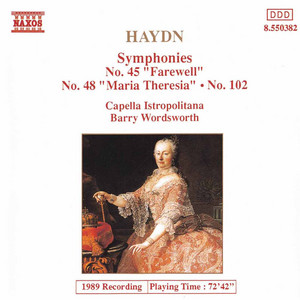 | Symphony No. 45 in F-Sharp Minor, Hob.I:45, "Farewell": II. Adagio | Franz Joseph Haydn, Capella Istropolitana, Barry Wordsworth | A Major | 0 | 11B | 76 BPM | |
 | Hungarian Dances, WoO 1: No. 5 in G Minor. Allegro (Orch. Parlow) | Johannes Brahms, Berliner Philharmoniker, Herbert von Karajan | E♭ Major | 2 | 5B | 134 BPM | |
 | The Prince of Denmark's March | Jeremiah Clarke, Wynton Marsalis, Anthony Newman, English Chamber Orchestra | D Major | 2 | 10B | 127 BPM | |
 | Symphony No. 17 in C Major: III. Allegro assai | William Herschel, Matthias Bamert, London Mozart Players | A Major | 1 | 11B | 154 BPM | |
 | Serenade No. 5, Op. 3 | The Jane Austen Era | G Major | 1 | 9B | 95 BPM | |
 | Songs Without Words, Op. 30: No. 6, Venezianisches Gondellied (Allegretto tranquillo) | Felix Mendelssohn, Henrik Måwe | E Major | 0 | 12B | 72 BPM | |
 | Sinfonia In D Major, Wq. 183/1, H. 663 : I. Allegro Di Molto | Carl Philipp Emanuel Bach, Salzburg Chamber Philharmonic Orchestra | F Major | 0 | 7B | 133 BPM | |
 | The Swan | St. Mark's Philharmonic Orchestra | G Major | 0 | 9B | 85 BPM | |
 | Joyful Moments | Essential Band | E♭ Minor | 5 | 2A | 110 BPM | |
 | Les Beautés Du Diable | François Dompierre, Angèle Dubeau | E Minor | 1 | 9A | 132 BPM | |
 | Carnival of the Animals, R. 125: XIII. The Swan | Camille Saint-Saëns, Marylene Dosse, Annie Petit, Württembergisches Kammerorchester Heilbronn, Jörg Faerber | G Major | 1 | 9B | 83 BPM | |
 | String Quartet | Essential Band | D Major | 2 | 10B | 137 BPM | |
 | Peer Gynt Suite No. 1, Op. 46: I. Morning Mood | Edvard Grieg, Hamburg State Opera Orchestra, Wilhelm Brückner-Rüggeberg | E Major | 1 | 12B | 135 BPM |
- ISRC
- ZAVP02005736
- Label
- L-M Records/RCA Records