- BPM
- 89
- Key
- C Major
- Camelot
- 8B
Nabucco: Overture by Giuseppe Verdi, Orchester der Deutschen Oper Berlin, Giuseppe Sinopoli Song Details
Giuseppe Verdi, Orchester der Deutschen Oper Berlin, Giuseppe Sinopoli's 'Nabucco: Overture' had a release date set for January 1, 1983. Since This song is still less than 10 minute long, it is still considered a pretty long duration song compared to the average song length. This song does not appear to be explicit due to the lack of the "E" tag. This song is part of Verdi: Nabucco by Giuseppe Verdi, Orchester der Deutschen Oper Berlin, Giuseppe Sinopoli. The song's track number on the album is #1 out of 44 tracks. Based on our data, Germany was the country where this track was produced or recorded. Nabucco: Overture is below average in popularity right now. In our opinion, the overall tone is not very danceable and projects negative sounds, such as being sad, depressed, or angry.
BPM and Tempo
Since Nabucco: Overture by Giuseppe Verdi, Orchester der Deutschen Oper Berlin, Giuseppe Sinopoli has a tempo of 89 beats per a minute, the tempo markings of this song would be Andante (at a walking pace). With Nabucco: Overture being at 89 BPM, the half-time would be 44 BPM with a double-time of 178 BPM.In addition, we consider the tempo speed to be pretty slow for this song. This makes this song perfect for activities such as, yoga or pilates. The time signature for this track is 4/4.
Music Key
This song is in the music key of C Major. Or for those who are familiar with the camelot wheel, this song has a camelot key of 8B. So, the perfect camelot match for 8B would be either 8B or 9A. While, 9B can give you a low energy boost. For moderate energy boost, you would use 5B and a high energy boost can either be 10B or 3B. Though, if you want a low energy drop, you should looking for songs with either a camelot key of 8A or 7B will give you a low energy drop, 11B would be a moderate one, and 6B or 1B would be a high energy drop. Lastly, 5A allows you to change the mood.
Want to find the BPM and music key for other songs? Check out our BPM and Key Finder page!
- Popularity
- 31%
- Loudness
- -17.569 dB
- Acousticness
- 93%
- Danceability
- 32%
- Energy
- 14%
- Instrumentalness
- 74%
- Liveness
- 6%
- Loudness
- 71%
- Speechiness
- 7%
- Valence
- 22%
Recommendations
| Track | Artist | Key | Energy | Camelot | BPM | ||
|---|---|---|---|---|---|---|---|
 | Blue Danube (An der Schönen Blauen Donau) Waltz Op.314 | Vienna Volksoper Orchestra, Peter Falk | D Major | 0 | 10B | 96 BPM | |
 | Vert-Vert: Overture | Jacques Offenbach, Berliner Philharmoniker, Herbert von Karajan | G Major | 1 | 9B | 101 BPM | |
 | Marche slave, Op. 31, TH 45 | Pyotr Ilyich Tchaikovsky, Leonard Bernstein, New York Philharmonic | B♭ Minor | 4 | 3A | 109 BPM | |
 | Peer Gynt Suite No. 2, Op. 55: II. Arabian Dance | Edvard Grieg, Berliner Philharmoniker, Herbert von Karajan | F Major | 1 | 7B | 123 BPM | |
 | La Traviata: Prelude to Act I | Bonn Classical Philharmonic | B Major | 0 | 1B | 120 BPM | |
 | Symphonie fantastique, Op. 14, H 48: 2. Un bal (Valse: Allegro non troppo) | Hector Berlioz, Chicago Symphony Orchestra, Claudio Abbado | A Major | 1 | 11B | 84 BPM | |
 | Hungarian Rhapsody No. 2, S. 244/2 (Orch. Müller-Berghaus in C Minor) | Franz Liszt, Berliner Philharmoniker, Herbert von Karajan | F Minor | 2 | 4A | 170 BPM | |
 | Also sprach Zarathustra, Op.30, TrV 176: Prelude (Sonnenaufgang) | Richard Strauss, Berliner Philharmoniker, Herbert von Karajan | C Major | 3 | 8B | 72 BPM | |
 | Eugen Onegin: Polonaise | Rundfunkorchester Berlin, Heinz Fricke | G Major | 5 | 9B | 95 BPM | |
 | Die Walküre, WWV 86B / Act III: "Hojotoho! Heiaha!" | Richard Wagner, Liselotte Rebmann, Danica Mastilovic, Ingrid Steger, Lilo Brockhaus, Carlotta Ordassy, Barbro Ericson, Cvetka Ahlin, Helga Jenckel, Berliner Philharmoniker, Herbert von Karajan | G Major | 4 | 9B | 93 BPM | |
 | Night on Bald Mountain | Modest Mussorgsky, Leonard Bernstein, New York Philharmonic | D Major | 2 | 10B | 105 BPM | |
 | Carmen, Opera Suite No. 1: V. Seguedille, Act 1 | London Festival Orchestra, Alfred Scholz | D Major | 0 | 10B | 92 BPM | |
 | Gounod: Roméo et Juliette: Ouverture | Charles Gounod, Michel Plasson, Orchestre Du Capitole De Toulouse | D Minor | 3 | 7A | 123 BPM | |
 | Radetzky March Op. 228 | Riccardo Muti, Wiener Philharmoniker | A Major | 5 | 11B | 106 BPM | |
 | Carmina Burana: IV. Omnia Sol temperat | Carl Orff, Dietrich Fischer-Dieskau, Orchester der Deutschen Oper Berlin, Eugen Jochum | B♭ Major | 0 | 6B | 76 BPM | |
 | Scheherazade: The Sea & Sinbad's Ship | Nikolai Rimsky-Korsakov, Lars Hjalmar Joakim | E Major | 1 | 12B | 82 BPM | |
| Carmina Burana / Fortuna Imperatrix Mundi: "Fortune plango vulnera" | Carl Orff, Chor der Deutschen Oper Berlin, Orchester der Deutschen Oper Berlin, Eugen Jochum | B♭ Major | 2 | 6B | 132 BPM | |
 | Verdi: Messa da Requiem: XV. Sanctus | Giuseppe Verdi, Claudio Abbado, Eric Ericson Chamber Choir, Orfeon Donostiarra, Swedish Radio Choir, Berliner Philharmoniker | F Major | 2 | 7B | 114 BPM | |
 | Hungarian Dances, WoO 1: No. 1 in G Minor | Johannes Brahms, Cristian Mandeal, George Enescu Philharmonic Orchestra, Bucharest | G Minor | 2 | 6A | 73 BPM | |
| Carmina Burana / Uf dem Anger: Reie - "Swaz hie gat umbe" - "Chume, chum geselle min" | Carl Orff, Chor der Deutschen Oper Berlin, Orchester der Deutschen Oper Berlin, Eugen Jochum | F Major | 0 | 7B | 135 BPM | |
 | Symphony No. 9 in E Minor, Op. 95 "From the New World": III. Scherzo. Molto vivace | Antonín Dvořák, New York Philharmonic, Alan Gilbert | C Major | 1 | 8B | 121 BPM | |
 | Les contes d'Hoffmann: "Barcarole" | Philharmonia Orchestra, Herbert von Karajan | D Major | 0 | 10B | 76 BPM | |
 | L'elisir d'amore: Overture (Preludio) | Gaetano Donizetti, English Chamber Orchestra, Richard Bonynge | D Major | 0 | 10B | 169 BPM | |
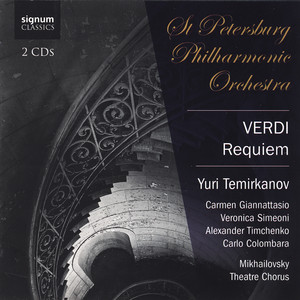 | Sanctus | Giuseppe Verdi, Carmen Giannattasio, Veronica Simeoni, Alxander Timchenko, Carlo Colombara, Yuri Temirkanov, St. Petersburg Philharmonic Orchestra | F Major | 3 | 7B | 114 BPM | |
 | Symphony No. 1 in D Major: III. Feierlich und gemessen, ohne zu schleppen - Live | Gustav Mahler, Berliner Philharmoniker, Claudio Abbado | G Minor | 0 | 6A | 56 BPM |
- ISRC
- DEF058230601
- Label
- L-M Records/RCA Records