- BPM
- 69
- Key
- F♯ Minor
- Camelot
- 11A
Variations on a Rococo Theme, Op.33, TH.57: Moderato assai quasi andante by Pyotr Ilyich Tchaikovsky, Mstislav Rostropovich, Leningrad Philharmonic Orchestra, Gennady Rozhdestvensky Song Details
"Variations on a Rococo Theme, Op.33, TH.57: Moderato assai quasi andante" by Pyotr Ilyich Tchaikovsky, Mstislav Rostropovich, Leningrad Philharmonic Orchestra, Gennady Rozhdestvensky had its release date on January 1, 1961. With This song being less than a minute long, we are pretty confident that this song does not contain any foul language. That being said, this song is pretty short compared to other songs. There are a total of 15 in the song's album "Shostakovich: Cello Concerto No. 2. Tchaikovsky: Rococo Variations; Andante cantabile. Glazunov: Chant du Ménestrel". In this album, this song's track order is #4. Variations on a Rococo Theme, Op.33, TH.57: Moderato assai quasi andante is not that popular right now. In our opinion, the overall tone is not very danceable and projects negative sounds, such as being sad, depressed, or angry.
BPM and Tempo
With Variations on a Rococo Theme, Op.33, TH.57: Moderato assai quasi andante by Pyotr Ilyich Tchaikovsky, Mstislav Rostropovich, Leningrad Philharmonic Orchestra, Gennady Rozhdestvensky having a BPM of 69 with a half-time of 34 BPM and a double-time of 138 BPM, we would consider this track to have a Adagio (slowly with great expression) tempo marking. Because of this, we believe that the song has an overall slow tempo. The time signature for this track is 3/4.
Music Key
This song has a musical key of F♯ Minor. Or for those who are familiar with the camelot wheel, this song has a camelot key of 11A. So, the perfect camelot match for 11A would be either 11A or 10B. While, a low energy boost can consist of either 11B or 12A. For moderate energy boost, you would use 8A and a high energy boost can either be 1A or 6A. However, if you are looking for a low energy drop, finding a song with a camelot key of 10A would be a great choice. Where 2A would give you a moderate drop, and 9A or 4A would be a high energy drop. Lastly, 2B allows you to change the mood.
Want to find the BPM and music key for other songs? Check out our BPM and Key Finder page!
- Popularity
- 3%
- Loudness
- -24.144 dB
- Acousticness
- 99%
- Danceability
- 25%
- Energy
- 1%
- Instrumentalness
- 81%
- Liveness
- 12%
- Loudness
- 60%
- Speechiness
- 4%
- Valence
- 14%
Recommendations
| Track | Artist | Key | Energy | Camelot | BPM | ||
|---|---|---|---|---|---|---|---|
 | Waltz No. 19 in A minor, Op. posth. | Frédéric Chopin, Peter Jablonski | A Minor | 0 | 8A | 69 BPM | |
 | Polonaise in A-Flat Major, Op. 53 | Frédéric Chopin, Evgeny Kissin | A♭ Major | 3 | 4B | 85 BPM | |
 | La bayadère: Variation 3: Moderato | Ludwig Minkus, Anna Takova-Baynova, Valentina Raicheva, Sofia National Opera Orchestra, Boris Spassov | D Major | 0 | 10B | 78 BPM | |
 | Consolation No. 3 in D-Flat Major, S. 172/3 | Franz Liszt, Vladimir Horowitz | D♭ Major | 0 | 3B | 70 BPM | |
 | Six Pieces, Op. 51, TH 143: VI. Valse sentimentale. Tempo di Valse | Pyotr Ilyich Tchaikovsky, Daniel Lozakovich, Stanislav Soloviev | D♭ Major | 1 | 3B | 108 BPM | |
 | Aleko: Intermezzo | Sergei Rachmaninoff, Berliner Philharmoniker, Lorin Maazel | B♭ Major | 0 | 6B | 90 BPM | |
 | Introduction and Rondo capriccioso in A Minor | Camille Saint-Saëns, Dong-Suk Kang, Polish National Radio Symphony Orchestra, Antoni Wit | A Minor | 1 | 8A | 91 BPM | |
 | Gold Und Silber (Gold And Silver), Op. 79 | Slovak Radio Symphony Orchestra, Franz Lehár | C Major | 1 | 8B | 81 BPM | |
 | Piano Sonata No. 14 in C-Sharp Minor, Op. 27 No. 2 "Moonlight": I. Adagio sostenuto | Ludwig van Beethoven, Paul Lewis | D♭ Minor | 0 | 12A | 172 BPM | |
 | The Snow Maiden, Op. 12: I. Introduction | Moscow Symphony Orchestra, Moscow Capella, Elena Okolysheva, Arkady Mishenkin, Pyotr Ilyich Tchaikovsky | C Major | 0 | 8B | 91 BPM | |
 | Tchaikovsky: The Sleeping Beauty, Op. 66, Act I "The Spell": No. 6, Waltz | Pyotr Ilyich Tchaikovsky, Willi Boskovsky/Wiener Symphoniker, Willi Boskovsky, Wiener Symphoniker | G Major | 2 | 9B | 131 BPM | |
 | Lieder ohne Worte (Songs without Words), Book 2, Op. 30: No. 7 in E-Flat Major, Op. 30, No. 1, MWV U103 | Felix Mendelssohn, Péter Nagy | E♭ Major | 0 | 5B | 65 BPM | |
 | 8 Slavonic Dances, Op.46, B.83: No.1 in C (Presto) | Antonín Dvořák, Czech Philharmonic Orchestra, Jiří Bělohlávek | G Major | 2 | 9B | 106 BPM | |
 | Coppelia: Act I - Prelude | Léo Delibes, Slovak Radio Symphony Orchestra, Andrew Mogrelia | D Major | 0 | 10B | 88 BPM | |
 | Requiem: IIa. Dies irae | Giuseppe Verdi, Mariinsky Chorus, Mariinsky Orchestra, Valery Gergiev | C Minor | 4 | 5A | 88 BPM | |
 | Andante and Finale, Op. 79 (orch. S. Taneyev): Andante | Polish National Radio Symphony Orchestra, Bernd Glemser, Pyotr Ilyich Tchaikovsky | B♭ Major | 0 | 6B | 97 BPM | |
 | Ständchen, S. 560 (Trans. from Schwanengesang No. 4, D. 957) | Franz Schubert, Franz Liszt, Khatia Buniatishvili | D Major | 0 | 10B | 67 BPM | |
 | Slavonic March, Op. 31, TH 45 | Pyotr Ilyich Tchaikovsky, Russian National Orchestra, Mikhail Pletnev | B♭ Minor | 2 | 3A | 110 BPM | |
![Die Flamme von Paris (Flames of Paris), Act IV: Coda [arr. March] by Boris Vladimirovich Asafiev, Sofia National Opera Orchestra, Boris Spassov](https://i.scdn.co/image/ab67616d00001e020d73d1173789e937d83fa6c9) | Die Flamme von Paris (Flames of Paris), Act IV: Coda [arr. March] | Boris Vladimirovich Asafiev, Sofia National Opera Orchestra, Boris Spassov | C Major | 4 | 8B | 135 BPM | |
 | La Bayadere, Act III: 39. "Entrance of the Shades" | Evergreen Symphony Orchestra, Kevin Galiè | D Major | 0 | 10B | 76 BPM | |
 | 16 Waltzes, Op. 39: No. 15 In A Flat Major | Johannes Brahms, Idil Biret | A♭ Major | 0 | 4B | 68 BPM | |
 | Wiener Blut, Op. 354 | Johann Strauss II, Vienna Volksoper Orchestra, Franz Bauer-Theussl | D Major | 2 | 10B | 93 BPM | |
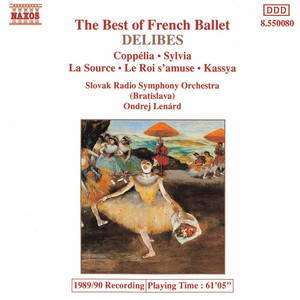 | Le roi s'amuse: Passepied | Léo Delibes, Slovak Philharmonic, Ondrej Lenard | A Major | 1 | 11B | 88 BPM | |
 | Pavane, Op. 50 | Gabriel Fauré, Sinfonieorchester Basel, Ivor Bolton | F♯ Minor | 0 | 11A | 66 BPM | |
 | Giselle: No. 21 - Andante | Adolphe Adam, Michael Tilson Thomas, London Symphony Orchestra | E♭ Major | 0 | 5B | 73 BPM |
- ISRC
- This song does not have an ISRC.
- Label
- L-M Records/RCA Records