- BPM
- 68
- Key
- C Major
- Camelot
- 8B
La traviata, Act II: "Di Provenza" - Instrumental Version by Giuseppe Verdi, Orchestra Sinfonica Moldava, Silvano Frontalini Song Details
"La traviata, Act II: "Di Provenza" - Instrumental Version" by Giuseppe Verdi, Orchestra Sinfonica Moldava, Silvano Frontalini had its release date on May 4, 2015. With this song being around four minutes long, at 4:20, the duration of this song is pretty average compared to other songs. This track is safe for children and doesn't appear to contain any foul language, since the "Explicit" tag was not present in this track. The song is number 5 out of 12 in Arias for Baritone Only Music by Giuseppe Verdi, Silvano Frontalini, Orchestra Sinfonica Moldava. Going off of the ISRC code of this track, we detected that the origin of this track is from Italy. La traviata, Act II: "Di Provenza" - Instrumental Version is unknown right now. In our opinion, the overall tone is not very danceable and projects negative sounds, such as being sad, depressed, or angry.
BPM and Tempo
The tempo marking of La traviata, Act II: "Di Provenza" - Instrumental Version by Giuseppe Verdi, Orchestra Sinfonica Moldava, Silvano Frontalini is Adagio (slowly with great expression), since this song has a tempo of 68 BPM. With that information, we can conclude that the song has a slow tempo. The time signature for this track is 3/4.
Music Key
This song is in the music key of C Major. This also means that this song has a camelot key of 8B. So, the perfect camelot match for 8B would be either 8B or 9A. While, 9B can give you a low energy boost. For moderate energy boost, you would use 5B and a high energy boost can either be 10B or 3B. Though, if you want a low energy drop, you should looking for songs with either a camelot key of 8A or 7B will give you a low energy drop, 11B would be a moderate one, and 6B or 1B would be a high energy drop. Lastly, 5A allows you to change the mood.
Want to find the BPM and music key for other songs? Check out our BPM and Key Finder page!
- Popularity
- 0%
- Loudness
- -18.93 dB
- Acousticness
- 96%
- Danceability
- 24%
- Energy
- 4%
- Instrumentalness
- 94%
- Liveness
- 21%
- Loudness
- 68%
- Speechiness
- 5%
- Valence
- 16%
Recommendations
| Track | Artist | Key | Energy | Camelot | BPM | ||
|---|---|---|---|---|---|---|---|
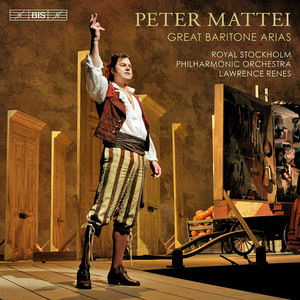 | Il barbiere di Siviglia (the Barber of Seville), Act I: Cavatina. Largo al factotum della citta | Gioachino Rossini, Peter Mattei, Royal Stockholm Philharmonic Orchestra, Lawrence Renes | C Major | 3 | 8B | 100 BPM | |
 | Don Giovanni, ossia Il dissoluto punito, K.527 / Act 2: "Don Giovanni, a cenar teco m'invitasti" | Wolfgang Amadeus Mozart, Paata Burchuladze, Samuel Ramey, Ferruccio Furlanetto, Berliner Philharmoniker, Herbert von Karajan, Chor der Deutschen Oper Berlin | B♭ Major | 3 | 6B | 76 BPM | |
 | Giulio Cesare, HWV 17, Act III Scene 1: Flow, my tears (Cleopatra) | George Frideric Handel, Sir Charles Mackerras, English National Opera Orchestra, Valerie Masterson | E Major | 0 | 12B | 65 BPM | |
 | Tannhäuser, WWV 70, Act II: Dich, teure Halle, grüß ich wieder | Richard Wagner, Lise Davidsen, Philharmonia Orchestra, Esa-Pekka Salonen | E Minor | 2 | 9A | 169 BPM | |
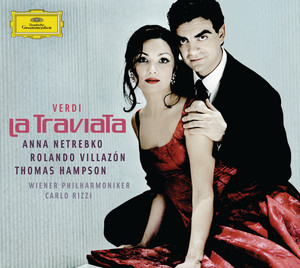 | La traviata / Act 1: "Dell'invito trascorsa è già l'ora" | Giuseppe Verdi, Anna Netrebko, Helene Schneiderman, Herman Wallen, Salvatore Cordella, Rolando Villazón, Paul Gay, Wiener Philharmoniker, Carlo Rizzi, Vienna State Opera Chorus, Rupert Huber | A Major | 2 | 11B | 82 BPM | |
 | Norma (1997 Digital Remaster): Casta Diva | Maria Callas, Tullio Serafin, Orchestra Del Teatro Alla Scala, Milano | F Major | 1 | 7B | 169 BPM | |
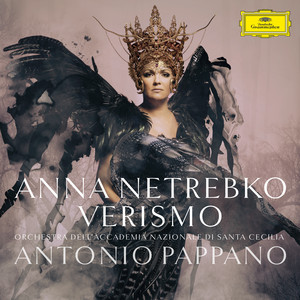 | Adriana Lecouvreur / Act 1: "Ecco: respiro appena ... Io son l'umile ancella" | Francesco Cilea, Anna Netrebko, Orchestra dell'Accademia Nazionale di Santa Cecilia, Antonio Pappano | A♭ Major | 1 | 4B | 82 BPM | |
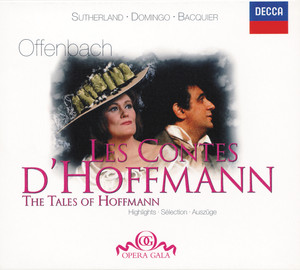 | Les Contes d'Hoffmann / Act 2: "Belle nuit, ô nuit d'amour" | Jacques Offenbach, Dame Joan Sutherland, Huguette Tourangeau, Chorus Pro Arte Lausanne Du Brassus, Radio Suisse Romande Chorus, Orchestre de la Suisse Romande, Richard Bonynge | D Major | 1 | 10B | 82 BPM | |
 | Verdi: I Vespri Siciliani, Act 1: Sinfonia | Giuseppe Verdi, Orchestra Del Teatro Alla Scala, Milano, Riccardo Muti | A Major | 1 | 11B | 123 BPM | |
 | Messa da Requiem: Confutatis | Giuseppe Verdi, Elena Filipova, Gloria Scalchi, Cesar Hernandez, Carlo Colombara, Hungarian State Opera Chorus, Hungarian State Opera Orchestra, Pier Giorgio Morandi | F♯ Major | 0 | 2B | 81 BPM | |
 | Requiem, K. 626: VII. Agnus Dei | Wolfgang Amadeus Mozart, Anna Tomowa-Sintow, Wiener Singverein, Wiener Philharmoniker, Herbert von Karajan | F Major | 1 | 7B | 87 BPM | |
 | Roméo et Juliette, CG 9 / Act 1: "Ah, je veux vivre dans ce rève" | Charles Gounod, Aida Garifullina, Vienna Radio Symphony Orchestra, Cornelius Meister | C Major | 3 | 8B | 77 BPM | |
 | Don Giovanni, K.527 / Act 1: "Là ci darem la mano" | Wolfgang Amadeus Mozart, Cecilia Bartoli, Bryn Terfel, Orchestra dell'Accademia Nazionale di Santa Cecilia, Myung-Whun Chung | D♭ Major | 2 | 3B | 82 BPM | |
 | Carmina Burana: XI. Estuans interius | Carl Orff, Dietrich Fischer-Dieskau, Orchester der Deutschen Oper Berlin, Eugen Jochum | A Minor | 4 | 8A | 84 BPM | |
 | Aida: Act II: Marcia | Giuseppe Verdi, Maria Dragoni, Kristjan Johannsson, Barbara Dever, Mark Rucker, Francesco Ellero d' Artegna, Riccardo Ferrari, Antonio Marcenò, Monica Trini, Colin Mawby, RTÉ Philharmonic Choir, RTE Chamber Choir, Culwick Choral Society, Bray Choral Society, Dublin County Choir, Dun Laoghaire Choral Society, Cantabile Singers, Goethe Institut Choir, Musica Sacra, The Phoenix Singers, RTÉ National Symphony Orchestra, Irish Army No. 1 Band, Ricco Saccani | A♭ Major | 1 | 4B | 112 BPM | |
 | Bizet: Les pêcheurs de perles, Act 1: "Au fond du temple saint" (Nadir, Zurga) | Georges Bizet, Carlo Rizzi, Orchestra of Welsh National Opera | A♭ Major | 0 | 4B | 181 BPM | |
 | Nessun Dorma! | Mario del Monaco | D♭ Major | 2 | 3B | 82 BPM | |
 | Addio fiorito asil | Carlo Bergonzi | D♭ Major | 2 | 3B | 74 BPM | |
 | Verdi: Aida, Act 1: "Sì, corre voce che l'Etiope ardisca" (Ramfis, Radamès) | Giuseppe Verdi, Riccardo Muti, Nicolai Ghiaurov, Plácido Domingo, New Philharmonia Orchestra | G Major | 1 | 9B | 77 BPM | |
 | Mattinata (Orch. Faris) | Ruggero Leoncavallo, Luciano Pavarotti, Philharmonia Orchestra, Piero Gamba | E Major | 3 | 12B | 79 BPM | |
 | Una voce poco fa from Il Barbiere di Siviglia, '(The) Barber of Seville' | Maria Callas, Philharmonia Orchestra, Tullio Serafin | E Major | 1 | 12B | 136 BPM | |
 | Requiem, K. 626: Rex tremendae | Wolfgang Amadeus Mozart, Academy of Ancient Music, Stephen Cleobury, Choir of King's College, Cambridge | G Minor | 2 | 6A | 101 BPM | |
 | Nabucco: Va, pensiero, sull'ali dorate (Chorus of the Hebrew Slaves) | Renato Cellini, Robert Shaw | A♭ Major | 1 | 4B | 168 BPM | |
 | Le nozze di Figaro, K. 492, Act I: No. 10, Non più andrai | Wolfgang Amadeus Mozart, Bryn Terfel, Scottish Chamber Orchestra, Sir Charles Mackerras | G Major | 2 | 9B | 134 BPM | |
 | Cavalleria rusticana: Intermezzo | Pietro Mascagni, National Philharmonic Orchestra, Gianandrea Gavazzeni, Giuseppe Patanè | F Major | 2 | 7B | 81 BPM |
- ISRC
- ITD541500361
- Label
- L-M Records/RCA Records