- BPM
- 180
- Key
- E Minor
- Camelot
- 9A
Keyboard Suite No. 3 (Set I) in D Minor, HWV 428: III. Allemande by George Frideric Handel, Philip Edward Fisher Song Details
On March 30, 2010, the song "Keyboard Suite No. 3 (Set I) in D Minor, HWV 428: III. Allemande" was released by George Frideric Handel, Philip Edward Fisher. This song is about six minutes long, preciously at 5:48, making this song fairly long compared to other songs. The track order of this song in George Frideric Handel, Philip Edward Fisher's "Handel: Keyboard Suites, Vol. 1" album is number 11 out of 20. On top of that, Hong Kong appears to be the country where this track was created. The popularity of Keyboard Suite No. 3 (Set I) in D Minor, HWV 428: III. Allemande is currently unknown right now. The overall mood can be danceable to some, especially with it's high amount of postive energy.
BPM and Tempo
We consider the tempo marking of Keyboard Suite No. 3 (Set I) in D Minor, HWV 428: III. Allemande by George Frideric Handel, Philip Edward Fisher to be Presto (very, very fast) because the track has a tempo of 180 BPM, a half-time of 90BPM, and a double-time of 360 BPM. Based on that, the speed of the song's tempo is fast. The time signature for this track is 4/4.
Music Key
This song is in the music key of E Minor. Because this track belongs in the E Minor key, the camelot key is 9A. So, the perfect camelot match for 9A would be either 9A or 8B. While, a low energy boost can consist of either 9B or 10A. For moderate energy boost, you would use 6A and a high energy boost can either be 11A or 4A. However, if you are looking for a low energy drop, finding a song with a camelot key of 8A would be a great choice. Where 12A would give you a moderate drop, and 7A or 2A would be a high energy drop. Lastly, 12B allows you to change the mood.
Want to find the BPM and music key for other songs? Check out our BPM and Key Finder page!
- Popularity
- 0%
- Loudness
- -20.396 dB
- Acousticness
- 99%
- Danceability
- 42%
- Energy
- 32%
- Instrumentalness
- 91%
- Liveness
- 14%
- Loudness
- 66%
- Speechiness
- 7%
- Valence
- 97%
Recommendations
| Track | Artist | Key | Energy | Camelot | BPM | ||
|---|---|---|---|---|---|---|---|
 | II. Adagio cantabile from Piano Sonata No. 8 in C minor, Op. 13 "Pathetique" - Instrumental | Ludwig van Beethoven, Murray Perahia | A♭ Major | 0 | 4B | 62 BPM | |
 | Water Music Suite No. 1 (Excerpts): 6. Minuet | George Frideric Handel, New York Philharmonic, Pierre Boulez | F Major | 0 | 7B | 102 BPM | |
 | Overture No. 6 in B-Flat Major: II. Largo | Francesco Maria Veracini, L'Arte dell' Arco, Federico Guglielmo | F♯ Major | 0 | 2B | 96 BPM | |
 | Symphony No. 5 in D Major, Op. 2, "St. Cecilia's Day Ode": I. Allegro ma non troppo - Allegro assai | William Boyce, Aradia Ensemble, Kevin Mallon | D♭ Major | 2 | 3B | 126 BPM | |
 | 12 Concerti Grossi, Op. 6, No. 8 in G Minor "Fatto per la notte di Natale": V. Allegro & VI. Largo. Pastorale ad libitum | Arcangelo Corelli, Karol Teutsch, Orchestre Leopoldinum-wroclaw | G Major | 1 | 9B | 117 BPM | |
 | Suite No. 3, P. 172: I. Italiana: Andantino | Ottorino Respighi, RTÉ National Symphony Orchestra | B♭ Major | 1 | 6B | 94 BPM | |
 | Stabat Mater, P. 77: II. Soprano. Cuius animam gementem | Giovanni Battista Pergolesi, Emma Kirkby, Academy of Ancient Music, Christopher Hogwood | G Major | 1 | 9B | 79 BPM | |
 | Minuet in A major, D. 334 | Franz Schubert, Arcadi Volodos | A Major | 0 | 11B | 92 BPM | |
| Stabat Mater, P. 77: V. Duet. Quis est homo qui non fleret | Giovanni Battista Pergolesi, Emma Kirkby, James Bowman, Academy of Ancient Music, Christopher Hogwood | B Minor | 1 | 10A | 80 BPM | |
| Overture No. 6 in B-Flat Major: I. Allegro | Francesco Maria Veracini, L'Arte dell' Arco, Federico Guglielmo | F♯ Minor | 3 | 11A | 178 BPM | |
 | Les Pleurs (Mr. de Sainte Colombe, version viole seule de Jordi Savall) | Monsieur de Sainte-Colombe, Jordi Savall | D♭ Minor | 0 | 12A | 102 BPM | |
 | Keyboard Concerto in E-Flat Major, Op. 7. No. 5, W. C59: II. Andante | Johann Christian Bach, Anastasia Injushina, Hamburger Camerata, Ralf Gothoni | C Minor | 0 | 5A | 84 BPM | |
 | Tu mancavi a tormentarmi, crudelissima speranza (Arr. L. Stokowski) | Antonio Cesti, Brussels Philharmonic, Richard Egarr | E Major | 1 | 12B | 87 BPM | |
 | String Quintet in E Major, G. 275: III. Minuetto - Trio | Luigi Boccherini, Cuarteto Casals, Eckart Runge | A Major | 0 | 11B | 127 BPM | |
 | Flute Concerto in D Minor, QV 5:81: II. Arioso | Johann Joachim Quantz, Mary Oleskiewicz, Concerto Armonico Budapest, Miklós Spányi | G Minor | 2 | 6A | 77 BPM | |
 | Concerto for 2 Oboes in F Major, Op. 9, No. 3: II. Adagio (non troppo) | Tomaso Albinoni, Anthony Camden, London Virtuosi, John Georgiadis | D Minor | 1 | 7A | 61 BPM | |
 | Orfeo ed Euridice, Wq. 30, Act II: Danse des champs-elysées "Mélodie" (Arr. for Piano by Ignaz Friedman) | Christoph Willibald Gluck, Joseph Banowetz | A Major | 0 | 11B | 72 BPM | |
 | Overture (Suite) In C Major, TWV 55: C6: I. Ouverture: Grave. Allegro. Grave | Cologne Chamber Orchestra, Georg Philipp Telemann | G Major | 3 | 9B | 116 BPM | |
 | Symphony No. 5 in D Major: 1. Allegro ma non troppo - Allegro assai | William Boyce, Academy of Ancient Music, Christopher Hogwood | D♭ Major | 2 | 3B | 131 BPM | |
 | Fauré: Pavane, Op. 50 (Instrumental Version) | Gabriel Fauré, Sir Neville Marriner, Academy of St. Martin in the Fields | F♯ Minor | 1 | 11A | 70 BPM | |
 | Trumpet Sonata in D Major, Z. 850: I. Allegro | Henry Purcell, Ede Inhoff, Hungarian State Opera Chamber Orchestra | E♭ Minor | 0 | 2A | 83 BPM | |
 | Oboe Concerto in A Major (arr. J. Barbirolli): V. Giga | Arcangelo Corelli, Anthony Camden, City of London Sinfonia, Nicholas Ward | F Major | 0 | 7B | 104 BPM | |
 | Concerto For Oboe In D Minor - Presto | Tafelmusik Baroque Orchestra | D♭ Minor | 3 | 12A | 104 BPM | |
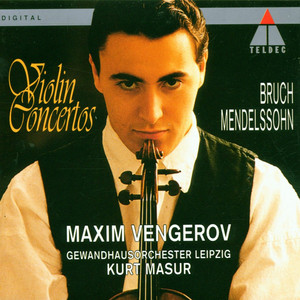 | Bruch: Violin Concerto No. 1 in G Minor, Op. 26: I. Prelude. Allegro moderato | Max Bruch, Maxim Vengerov, Kurt Masur, Gewandhausorchester | E♭ Major | 1 | 5B | 113 BPM | |
 | Oboe Concerto in D Minor, Op. 9 No. 2: II. Adagio | Tomaso Albinoni, David Reichenberg, The English Concert, Trevor Pinnock | A Major | 1 | 11B | 68 BPM |
- ISRC
- HKI190903511
- Label
- L-M Records/RCA Records