- BPM
- 91
- Key
- B♭ Major
- Camelot
- 6B
String Quartet in C Major, Hob.III:39, (Op. 33 No. 3): 1. Allegro moderato by Joseph Haydn, The Angeles String Quartet Song Details
"String Quartet in C Major, Hob.III:39, (Op. 33 No. 3): 1. Allegro moderato" by Joseph Haydn, The Angeles String Quartet had its release date on January 1, 2000. Since This song is still less than 10 minute long, it is still considered a pretty long duration song compared to the average song length. This song does not appear to be explicit due to the lack of the "E" tag. The track order of this song in Franz Joseph Haydn, The Angeles String Quartet's "Haydn: Complete String Quartets" album is number 9 out of 280. On top of that, United Kingdom appears to be the country where this track was created. In terms of popularity, String Quartet in C Major, Hob.III:39, (Op. 33 No. 3): 1. Allegro moderato is currently not that popular. In our opinion, the overall tone is not very danceable and projects negative sounds, such as being sad, depressed, or angry.
BPM and Tempo
We consider the tempo marking of String Quartet in C Major, Hob.III:39, (Op. 33 No. 3): 1. Allegro moderato by Joseph Haydn, The Angeles String Quartet to be Andante (at a walking pace) because the track has a tempo of 91 BPM, a half-time of 46BPM, and a double-time of 182 BPM. Based on that, the speed of the song's tempo is slow. Activities such as, yoga or pilates, can go well with this song. The time signature for this track is 4/4.
Music Key
This song is in the music key of B♭ Major. This also means that this song has a camelot key of 6B. So, the perfect camelot match for 6B would be either 6B or 7A. While, 7B can give you a low energy boost. For moderate energy boost, you would use 3B and a high energy boost can either be 8B or 1B. Though, if you want a low energy drop, you should looking for songs with either a camelot key of 6A or 5B will give you a low energy drop, 9B would be a moderate one, and 4B or 11B would be a high energy drop. Lastly, 3A allows you to change the mood.
Want to find the BPM and music key for other songs? Check out our BPM and Key Finder page!
- Popularity
- 5%
- Loudness
- -23.136 dB
- Acousticness
- 97%
- Danceability
- 22%
- Energy
- 3%
- Instrumentalness
- 34%
- Liveness
- 17%
- Loudness
- 61%
- Speechiness
- 5%
- Valence
- 9%
Recommendations
| Track | Artist | Key | Energy | Camelot | BPM | ||
|---|---|---|---|---|---|---|---|
 | Symphony for Flute, Oboe, Horn and Strings in D Major: III. Presto | Domenico Cimarosa, Chopin Chamber Orchestra, Winston Dan Vogel | E♭ Major | 1 | 5B | 116 BPM | |
| Sinfonia in D Major, "Bologna" | Gioachino Rossini, Chopin Chamber Orchestra, Winston Dan Vogel | D Major | 0 | 10B | 79 BPM | |
 | Symphony No. 2 in C Major, Hob. I:2: III. Finale. Presto | Joseph Haydn, Austro-Hungarian Haydn Orchestra, Ádám Fischer | C Major | 1 | 8B | 118 BPM | |
 | Oboe Concerto No. 1 in D Minor: I. Allegro | Ludwig August Lebrun, Bart Schneemann, Radio Chamber Orchestra, Jan Willem de Vriend | D Minor | 1 | 7A | 134 BPM | |
 | Ein Sommernachtstraum (A Midsummer's Night Dream): VI. Notturno | Felix Mendelssohn, Orchestre des Champs-Élysées, Philippe Herreweghe | E Major | 0 | 12B | 89 BPM | |
 | Septet in E Flat Major, Op. 20: 1. Adagio - Allegro con brio | Ludwig van Beethoven, Berlin Philharmonic Octet | G Major | 0 | 9B | 72 BPM | |
 | Die Schöpfung Hob. XXI:2 / Erster Teil: Einleitung - Rezitativ und Chor: "Im Anfange" | Joseph Haydn, Gösta Winbergh, Kurt Moll, Berliner Philharmoniker, James Levine, Stockholm Radio Chorus, Stockholm Chamber Choir, Gustav Sjökvist | A♭ Major | 0 | 4B | 80 BPM | |
 | Concerto for 2 Flutes in D Major (Ed. P. Gallois): II. Largo | Saverio Mercadante, Patrick Gallois, Kazunori Seo, Czech Philharmonic Chamber Orchestra | D Minor | 0 | 7A | 70 BPM | |
 | Piano Concerto No. 4 in G Minor: I. Allegro | Giovanni Paisiello, Francesco Nicolosi, Collegium Philarmonicum Chamber Orchestra, Gennaro Cappabianca | E♭ Major | 2 | 5B | 135 BPM | |
 | Sunrise Chant | Nuit | C Major | 0 | 8B | 132 BPM | |
 | Sonata in D Minor, K. 9 | Domenico Scarlatti, Ivo Pogorelich | D Minor | 0 | 7A | 94 BPM | |
 | The Creation, Hob.XXI,2: Pt. 1, In the Beginning | Joseph Haydn, Handel and Haydn Society, Jeremy Ovenden, Matthew Brook, Harry Christophers | B♭ Minor | 0 | 3A | 103 BPM | |
 | Symphony No. 50 in D Minor, Op. 10, No. 5: III. Presto | Christian Cannabich, Nicolaus Esterhazy Sinfonia, Uwe Grodd | B Major | 1 | 1B | 176 BPM | |
 | Concerto in C Minor: IV. Allegro giusto | Domenico Cimarosa, John Anderson, Simon Wright, Philharmonia Orchestra | C Major | 2 | 8B | 111 BPM | |
 | Sonata No. 5 in A Major, Op. 17, No. 5: II. Presto | Johann Christian Bach, Daniil Trifonov | A Major | 2 | 11B | 67 BPM | |
 | Five Pieces for Two Violins & Piano (Edited from the Film Music for "The Gadfly" by L. Atovmyan): No. 3, Elegy [Arr. for String Quartet by Jacqueline Thomas] | Dmitri Shostakovich, Brodsky Quartet | C Major | 0 | 8B | 31 BPM | |
 | Symphony in G Minor, Op. 6, No. 6, W. C12: III. Allegro molto | Johann Christian Bach, Concerto Köln | F♯ Minor | 2 | 11A | 96 BPM | |
 | La cambiale di matrimonio: Overture | Gioachino Rossini, Academy of St. Martin in the Fields, Sir Neville Marriner | E♭ Major | 1 | 5B | 140 BPM | |
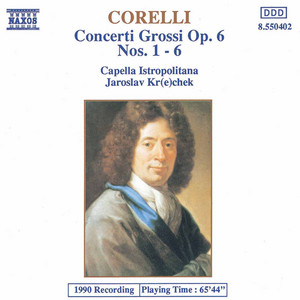 | Concerto Grosso In F Major, Op. 6, No. 2: I. Vivace - Allegro - Adagio - Vivace - Allegro - Largo Andante | Arcangelo Corelli, Quido Holbling, Ludovit Kanta, Anna Holbling, Daniela Ruso, Capella Istropolitana | F Major | 2 | 7B | 131 BPM | |
 | Terzetto in C Major, op. 74: I. Introduzione: Allegro ma non troppo - Live | Antonín Dvořák, Paul Neubauer, Arnaud Sussmann, Erin Keefe | C Minor | 2 | 5A | 132 BPM | |
 | Cello Concerto No. 2 in D Hob. VIIb:2 (Cadenzas: Lynn Harrell): III. Rondo (Allegro) - Cadenza | Lynn Harrell, Sir Neville Marriner, Academy of St. Martin in the Fields | D Major | 1 | 10B | 134 BPM | |
 | Achmet und Zenide, Act III: Ouverture | Paul Wranitzky, Czech Philharmonic Chamber Orchestra, Marek Štilec | D Major | 1 | 10B | 141 BPM | |
 | Overture (Suite) in G Major, TWV 55:G10, "Burlesque de Quixotte": I. Ouverture | Georg Philipp Telemann, Northern Chamber Orchestra, Nicholas Ward | A Major | 2 | 11B | 110 BPM | |
 | Concerto grosso in B flat major, Op. 3/2, HWV 313: III. Allegro | George Frideric Handel, Kammerorchester Basel | D♭ Minor | 3 | 12A | 148 BPM | |
 | Sinfonia Veneziana: III. Presto | Antonio Salieri, Matthias Bamert, London Mozart Players | G Major | 2 | 9B | 164 BPM |
- ISRC
- GBBBA0000521
- Label
- L-M Records/RCA Records