- BPM
- 100
- Key
- D Minor
- Camelot
- 7A
Two Melodies, Op. 53, for string Orchestra: Det første møte (First Encounter). Lento by Edvard Grieg, WDR Sinfonieorchester Köln, Eivind Aadland Song Details
"Two Melodies, Op. 53, for string Orchestra: Det første møte (First Encounter). Lento" by Edvard Grieg, WDR Sinfonieorchester Köln, Eivind Aadland had its release date on May 4, 2012. With this song being about 5 minutes long, at This song is fairly a long song compared to the average song length. This song does not have an "Explicit" tag, making it safe for all ages. The track order of this song in Edvard Grieg, WDR Sinfonieorchester Köln, Eivind Aadland's "Grieg: Complete Symphonic Works, Vol. II" album is number 9 out of 12. On top of that, Germany appears to be the country where this track was created. In terms of popularity, Two Melodies, Op. 53, for string Orchestra: Det første møte (First Encounter). Lento is currently not that popular. In our opinion, the overall tone is not very danceable and projects negative sounds, such as being sad, depressed, or angry.
BPM and Tempo
We consider the tempo marking of Two Melodies, Op. 53, for string Orchestra: Det første møte (First Encounter). Lento by Edvard Grieg, WDR Sinfonieorchester Köln, Eivind Aadland to be Andante (at a walking pace) because the track has a tempo of 100 BPM, a half-time of 50BPM, and a double-time of 200 BPM. Based on that, the speed of the song's tempo is slow. The time signature for this track is 4/4.
Music Key
D Minor is the music key of this track. Because this track belongs in the D Minor key, the camelot key is 7A. So, the perfect camelot match for 7A would be either 7A or 6B. While, a low energy boost can consist of either 7B or 8A. For moderate energy boost, you would use 4A and a high energy boost can either be 9A or 2A. However, if you are looking for a low energy drop, finding a song with a camelot key of 6A would be a great choice. Where 10A would give you a moderate drop, and 5A or 12A would be a high energy drop. Lastly, 10B allows you to change the mood.
Want to find the BPM and music key for other songs? Check out our BPM and Key Finder page!
- Popularity
- 1%
- Loudness
- -21.265 dB
- Acousticness
- 95%
- Danceability
- 27%
- Energy
- 5%
- Instrumentalness
- 80%
- Liveness
- 23%
- Loudness
- 65%
- Speechiness
- 4%
- Valence
- 8%
Recommendations
| Track | Artist | Key | Energy | Camelot | BPM | ||
|---|---|---|---|---|---|---|---|
 | Pelléas et Mélisande Suite, Op. 80: III. Sicilienne. Allegretto molto moderato | Gabriel Fauré, Berliner Philharmoniker, Daniel Barenboim | E♭ Major | 0 | 5B | 56 BPM | |
 | Die Nacht, D. deest (Arr. Lechner/Márquez for Cello & Guitar) | Franz Schubert, Anja Lechner, Pablo Marquez | G Major | 0 | 9B | 85 BPM | |
 | Symphony No. 3 in F Major, Op. 90: III. Poco allegretto | Johannes Brahms, David Zinman | C Minor | 0 | 5A | 173 BPM | |
 | Violin Partita No. 3 in E Major, BWV 1006: I. Preludio | Johann Sebastian Bach, Hilary Hahn | A Major | 3 | 11B | 126 BPM | |
 | The Well-Tempered Clavier I, Prelude & Fugue No. 1 in C Major, BWV 846: I. Prelude | Johann Sebastian Bach, Lang Lang | C Major | 1 | 8B | 134 BPM | |
 | 6 Studies in English Folksong (Version for Cello & Piano): No. 3, Larghetto "Van Dieman's Land" | Ralph Vaughan Williams, Gerald Peregrine, Antony Ingham | D Minor | 0 | 7A | 81 BPM | |
 | Piano Concerto No. 2 in F Major, Op. 102: II. Andante | Dmitri Shostakovich, Yuja Wang, Boston Symphony Orchestra, Andris Nelsons | F Major | 1 | 7B | 104 BPM | |
 | Symphony No. 5: IV. Adagietto. Sehr langsam | Gustav Mahler, Berliner Philharmoniker, Claudio Abbado | F Major | 0 | 7B | 91 BPM | |
 | Jazz Suite No. 2: IV. Waltz I | Dmitri Shostakovich, Royal Concertgebouw Orchestra, Riccardo Chailly | B♭ Major | 2 | 6B | 178 BPM | |
 | Carmen Suite No. 1 (Arr. E. Guiraud): IV. Séguedille | Georges Bizet, Orquestra Simfònica de Barcelona i Nacional de Catalunya, Pablo González | G Minor | 0 | 6A | 66 BPM | |
 | 3 Chorales, P. 167: No. 3, Andante (After J.S. Bach's BWV 645) | Ottorino Respighi, Seattle Symphony Orchestra, Gerard Schwarz | E♭ Major | 0 | 5B | 84 BPM | |
 | Humoresque No. 7 in G-flat Major, Op. 101 | Boston Symphony Orchestra, Yo-Yo Ma, Seiji Ozawa, Itzhak Perlman | F♯ Major | 1 | 2B | 83 BPM | |
 | Scheherazade: The Young Prince | Nikolai Rimsky-Korsakov, Lars Hjalmar Joakim | G Major | 1 | 9B | 91 BPM | |
 | Pavane, Op. 50 (Version for Orchestra) | Gabriel Fauré, Orchestre de Chambre de Lausanne, Renaud Capuçon | F♯ Minor | 0 | 11A | 70 BPM | |
 | Academic Festival Overture, Op. 80 | Johannes Brahms, Gewandhausorchester Leipzig, Riccardo Chailly | C Major | 2 | 8B | 77 BPM | |
 | Piano Concerto No. 2 in C Minor, Op. 18: II. Adagio sostenuto | Sergei Rachmaninoff, Royal Liverpool Philharmonic Orchestra, Simon Trpčeski, Vasily Petrenko | E Major | 0 | 12B | 67 BPM | |
 | Schumann: 12 Gedichte aus Liebesfrühling, Op. 37: No. 11: Warum willst du andre fragen | Clara Schumann, Anneleen Lenaerts, Dionysis Grammenos | A♭ Major | 0 | 4B | 71 BPM | |
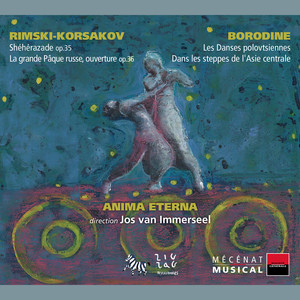 | Les danses polovtsiennes (Extraits de l'opéra Le Prince Igor): II. Danse des hommes | Alexander Borodin, Anima Eterna, Jos Van Immerseel | A Major | 0 | 11B | 87 BPM | |
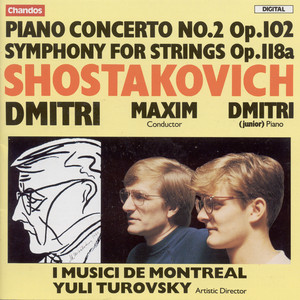 | Piano Concerto No. 2 in F Major, Op. 102: II. Andante | Dmitri Shostakovich, I Musici de Montréal, Maxim Shostakovich | C Minor | 0 | 5A | 177 BPM | |
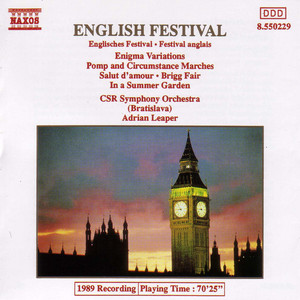 | Salut d'amour, Op. 12 (version for orchestra) | Edward Elgar, Slovak Radio Symphony Orchestra, Adrian Leaper | B♭ Major | 1 | 6B | 82 BPM | |
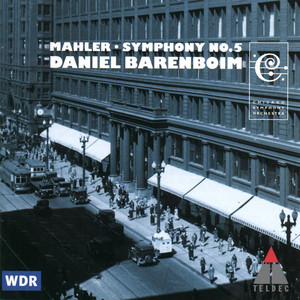 | Mahler: Symphony No. 5 in C-Sharp Minor: IV. Adagietto. Sehr langsam | Gustav Mahler, Daniel Barenboim, Chicago Symphony Orchestra | F Major | 1 | 7B | 82 BPM | |
 | Le roi s'amuse: Passepied | Léo Delibes, Slovak Philharmonic, Ondrej Lenard | A Major | 1 | 11B | 88 BPM | |
 | Piano Concerto No. 2 in C Minor, Op. 18: II. Adagio sostenuto | Sergei Rachmaninoff, Arthur Rubinstein, Fritz Reiner, Chicago Symphony Orchestra | E Major | 0 | 12B | 64 BPM | |
 | Haydn: Cello Concerto No. 1 in C Major, Hob. VIIb, 1: II. Adagio (Cadenza by Britten) | Franz Joseph Haydn, Mstislav Rostropovich, Academy of St. Martin in the Fields | F Major | 1 | 7B | 124 BPM | |
 | Suite No. 3, P. 172: III. Siciliana: Andantino | Ottorino Respighi, RTÉ National Symphony Orchestra | C Minor | 0 | 5A | 93 BPM |
- ISRC
- DEE211057909
- Label
- L-M Records/RCA Records