- BPM
- 75
- Key
- E♭ Major
- Camelot
- 5B
Stanza No. 2 "The Breakfast Room" BWV 773 - Edit Version by Johann Sebastian Bach, Ezio Bosso Song Details
"Stanza No. 2 "The Breakfast Room" BWV 773 - Edit Version" by Johann Sebastian Bach, Ezio Bosso had its release date on January 27, 2017. The duration of This song is about 3 minutes long, at 3:20. Based on our data, This song appears to be safe for all ages and is not considered explicit. This track is about the average length of a typical track. There are a total of 16 in the song's album "The 12th Room". In this album, this song's track order is #5. Furthermore, we believe that the track originated from Italy. Stanza No. 2 "The Breakfast Room" BWV 773 - Edit Version is not that popular right now. In our opinion, the overall tone is not very danceable and projects negative sounds, such as being sad, depressed, or angry.
BPM and Tempo
With Stanza No. 2 "The Breakfast Room" BWV 773 - Edit Version by Johann Sebastian Bach, Ezio Bosso having a BPM of 75 with a half-time of 38 BPM and a double-time of 150 BPM, we would consider this track to have a Adagio (slowly with great expression) tempo marking. Because of this, we believe that the song has an overall slow tempo. The time signature for this track is 3/4.
Music Key
This song is in the music key of E♭ Major. Or for those who are familiar with the camelot wheel, this song has a camelot key of 5B. So, the perfect camelot match for 5B would be either 5B or 6A. While, 6B can give you a low energy boost. For moderate energy boost, you would use 2B and a high energy boost can either be 7B or 12B. Though, if you want a low energy drop, you should looking for songs with either a camelot key of 5A or 4B will give you a low energy drop, 8B would be a moderate one, and 3B or 10B would be a high energy drop. Lastly, 2A allows you to change the mood.
Want to find the BPM and music key for other songs? Check out our BPM and Key Finder page!
- Popularity
- 5%
- Loudness
- -24.032 dB
- Acousticness
- 98%
- Danceability
- 27%
- Energy
- 2%
- Instrumentalness
- 95%
- Liveness
- 6%
- Loudness
- 60%
- Speechiness
- 4%
- Valence
- 7%
Recommendations
| Track | Artist | Key | Energy | Camelot | BPM | ||
|---|---|---|---|---|---|---|---|
 | Come, Sweet Death, BWV 478 (Arr. for 5 Cellos) | Sheku Kanneh-Mason, Hannah Roberts, Ben Davies, Desmond Neysmith, Max Ruisi | C Major | 0 | 8B | 122 BPM | |
 | Sinfonia in D Major, BWV 1045: I. Allegro | Johann Sebastian Bach, Robert Hill, Cologne Chamber Orchestra, Helmut Müller-Brühl | D Major | 3 | 10B | 98 BPM | |
 | Sonata in C Major, Kk. 159 | Domenico Scarlatti, Daniel Barenboim | C Major | 1 | 8B | 177 BPM | |
 | Suite in B-Flat Major, HWV 434: IV. Menuet | George Frideric Handel, Khatia Buniatishvili | G Minor | 0 | 6A | 59 BPM | |
 | Piano Sonata No. 8 in A Minor, K. 310: I. Allegro maestoso | Wolfgang Amadeus Mozart, Lars Vogt | B♭ Major | 1 | 6B | 77 BPM | |
 | Fantasia And Fugue In C Minor (Extracts), Bwv 906: Fantasia In C Minor, BWV 906 | Janos Sebestyen, Johann Sebastian Bach | C Minor | 3 | 5A | 107 BPM | |
 | Oboe Concerto in D Minor, S. Z799: I. Andante e spiccato | Alessandro Marcello, Marcel Ponseele, Il Gardellino | D Minor | 2 | 7A | 122 BPM | |
 | Bach, JS : Well-Tempered Clavier Book 1 : Fugue No.2 in C minor BWV847 | Daniel Barenboim | C Minor | 1 | 5A | 132 BPM | |
 | Zdes' khorosho ('How Fair This Spot'), Op. 21, No. 7 | Sergei Rachmaninoff, Pablo Ferrandez, Denis Kozhukhin | A Major | 0 | 11B | 87 BPM | |
 | Concerto Grosso in D Major, Op. 6 No. 4: II. Allegro | Arcangelo Corelli, Jordi Savall, Le Concert Des Nations | D♭ Major | 3 | 3B | 133 BPM | |
 | Rameau: Deuxième livre de pièces de clavecin, Suite en mi: V. Le rappel des oiseaux | Jean-Philippe Rameau, David Fray | E Minor | 1 | 9A | 71 BPM | |
 | Fantasie g-Moll "duobus subjectis" BWV 917 | Inge Rosar | A Minor | 3 | 8A | 64 BPM | |
 | Violin Concerto in E Major, Bwv 1042: II. Adagio | Arthur Grumiaux, Johann Sebastian Bach, Zurich Chamber Orchestra, Edmond De Stoutz | D♭ Minor | 1 | 12A | 79 BPM | |
 | Fugue in G minor, "little", BWV 578 | Bernard Lagacé | G Minor | 0 | 6A | 64 BPM | |
 | Chromatic Fantasy and Fuge, In D Minor BWV 903, Chromatische Fantasie and Fuge, D Moll BWV 903: Fantasie | Pieter-Jan Belder, Arts Music Recording, Rotterdam, Johann Sebastian Bach | C Minor | 3 | 5A | 76 BPM | |
 | Brandenburg Concerto No. 6 In B Flat Major, BWV 1051: I. Allegro | Cologne Chamber Orchestra, Johann Sebastian Bach | B♭ Major | 2 | 6B | 90 BPM | |
| Oboe Concerto in F Minor, TWV 51:F2: III. Vivace | Georg Philipp Telemann, Marcel Ponseele, Il Gardellino | A Minor | 1 | 8A | 159 BPM | |
 | Harpsichord Concerto No. 1 in D Minor, BWV 1052: I. Allegro | Johann Sebastian Bach, Gustav Leonhardt | D♭ Minor | 3 | 12A | 97 BPM | |
 | Bach, JS: Concerto for Four Pianos in A Minor, BWV 1065: III. Allegro | Johann Sebastian Bach, Michel Béroff, Jean-Philippe Collard, Gabriel Tacchino, Bruno Rigutto, Orchestre de chambre de Paris, Jean-Pierre Wallez | C Major | 2 | 8B | 83 BPM | |
| Fantasia And Fugue In A Minor, BWV 904 : Fantasia | Janos Sebestyen, Johann Sebastian Bach | C Major | 2 | 8B | 138 BPM | |
 | 4 Impromptus, Op.90, D.899: No.3 in G Flat Major: Andante | Franz Schubert, Radu Lupu | F♯ Major | 0 | 2B | 173 BPM | |
 | Ciacona in G Minor, Z. 730 | Henry Purcell, Orpheus Chamber Orchestra, Edward Brewer | G Minor | 1 | 6A | 138 BPM | |
 | Adagio in F, H.XVII No. 9 | Joseph Haydn, Alfred Brendel | F Major | 0 | 7B | 71 BPM | |
 | Concerto in C Minor: I. Introduzione - Larghetto | Domenico Cimarosa, John Anderson, Simon Wright, Philharmonia Orchestra | C Minor | 1 | 5A | 126 BPM | |
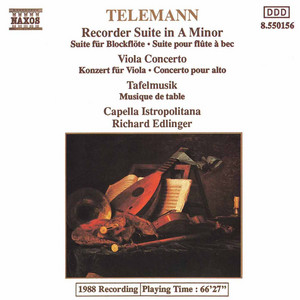 | Viola Concerto In G Major, TWV 51:g9: I. Largo | Ladislav Kyselák, Capella Istropolitana, Georg Philipp Telemann | G Major | 1 | 9B | 144 BPM |
- ISRC
- ITB001600957
- Label
- L-M Records/RCA Records