- BPM
- 64
- Key
- A Major
- Camelot
- 11B
Acis And Galatea - First Version: I Rage, I Melt, I Burn by George Frideric Handel, Willard White, English Baroque Soloists, John Eliot Gardiner Song Details
George Frideric Handel, Willard White, English Baroque Soloists, John Eliot Gardiner's ' "Acis And Galatea - First Version: I Rage, I Melt, I Burn" was released on its scheduled release date, January 1, 1978. With This song being less than two minutes long, at 1:23, we are fairly confident that this song is not explicit and is safe for all ages. Based on the duration of this song, this song duration is much smaller than the average song duration. The track order of this song in George Frideric Handel, Anthony Rolfe Johnson, Norma Burrowes, Paul Elliott, Martyn Hill, Willard White, English Baroque Soloists, John Eliot Gardiner's "Handel: Acis and Galatea" album is number 2 out of 29. On top of that, Germany appears to be the country where this track was created. Acis And Galatea - First Version: I Rage, I Melt, I Burn is unknown right now. Based on the vibe, this track doesn't seem to be that danceable, however its valence properties can make this some somewhat danceable.
BPM and Tempo
We consider the tempo marking of Acis And Galatea - First Version: I Rage, I Melt, I Burn by George Frideric Handel, Willard White, English Baroque Soloists, John Eliot Gardiner to be Larghetto (rather broadly) because the track has a tempo of 64 BPM, a half-time of 32BPM, and a double-time of 128 BPM. Based on that, the speed of the song's tempo is slow. The time signature for this track is 3/4.
Music Key
This song is in the music key of A Major. This also means that this song has a camelot key of 11B. So, the perfect camelot match for 11B would be either 11B or 12A. While, 12B can give you a low energy boost. For moderate energy boost, you would use 8B and a high energy boost can either be 1B or 6B. Though, if you want a low energy drop, you should looking for songs with either a camelot key of 11A or 10B will give you a low energy drop, 2B would be a moderate one, and 9B or 4B would be a high energy drop. Lastly, 8A allows you to change the mood.
Want to find the BPM and music key for other songs? Check out our BPM and Key Finder page!
- Popularity
- 0%
- Loudness
- -19.069 dB
- Acousticness
- 95%
- Danceability
- 38%
- Energy
- 22%
- Instrumentalness
- 12%
- Liveness
- 30%
- Loudness
- 68%
- Speechiness
- 4%
- Valence
- 56%
Recommendations
| Track | Artist | Key | Energy | Camelot | BPM | ||
|---|---|---|---|---|---|---|---|
 | Staircase Overture, Z. 614 | Henry Purcell, Christopher Hogwood, Paul O'Dette, Laurence Dreyfus, Academy of Ancient Music | A Major | 2 | 11B | 104 BPM | |
 | Concerto in C Minor: III. Siciliana | Domenico Cimarosa, John Anderson, Simon Wright, Philharmonia Orchestra | A Minor | 1 | 8A | 77 BPM | |
 | Pelléas et Mélisande, Op.80: 3. Sicilienne | Gabriel Fauré, Academy of St. Martin in the Fields, Sir Neville Marriner | G Minor | 0 | 6A | 111 BPM | |
 | Overture No. 6 in B-Flat Major: II. Largo | Francesco Maria Veracini, L'Arte dell' Arco, Federico Guglielmo | F♯ Major | 0 | 2B | 96 BPM | |
 | Purcell: Chacony in G Minor, Z. 730 | Henry Purcell, Sir Neville Marriner, Academy of St. Martin in the Fields | B♭ Major | 4 | 6B | 113 BPM | |
 | Brahms: Symphony No. 3 in F Major, Op. 90: III. Poco allegretto | Johannes Brahms, Nikolaus Harnoncourt, Berliner Philharmoniker | C Minor | 0 | 5A | 175 BPM | |
 | Holberg Suite, Op. 40: IV. Air (Andante religioso) | Edvard Grieg, Gothenburg Symphony Orchestra, Neeme Järvi | C Major | 1 | 8B | 79 BPM | |
 | Dvořák: 7 Gipsy Melodies, Op. 55, B. 104: No. 4, Als die alte Mutter (Transcr. for Trumpet and Orchestra) | Antonín Dvořák, Tine Thing Helseth, Eivind Aadland, Royal Liverpool Philharmonic Orchestra | D Major | 1 | 10B | 92 BPM | |
 | Savior of the Nations, Come, BWV 659 (Arr. for 4 Cellos) | Johann Sebastian Bach, Sheku Kanneh-Mason, Hannah Roberts, Ben Davies, Max Ruisi | C Major | 0 | 8B | 122 BPM | |
 | Concerto a due cori No. 1 in B flat (1989 Digital Remaster): II. Allegro | George Frideric Handel, Yehudi Menuhin, Menuhin Festival Orchestra | B♭ Major | 2 | 6B | 101 BPM | |
 | Albinoni: Adagio in G Minor | Tomaso Albinoni, Sir Neville Marriner, Academy of St. Martin in the Fields | C Minor | 1 | 5A | 90 BPM | |
 | Cello Concerto No. 1 in G Major: II. Romance. Andantino | Carl Stamitz, Christian Benda, Prague Chamber Orchestra | B♭ Major | 0 | 6B | 176 BPM | |
 | Stabat Mater, P. 77: V. Duet. Quis est homo qui non fleret | Giovanni Battista Pergolesi, Emma Kirkby, James Bowman, Academy of Ancient Music, Christopher Hogwood | B Minor | 1 | 10A | 80 BPM | |
 | Oboe Concerto in A Major (arr. J. Barbirolli): I. Preludio | Arcangelo Corelli, Anthony Camden, City of London Sinfonia, Nicholas Ward | F Major | 0 | 7B | 82 BPM | |
 | 3 Chorales, P. 167: No. 1, Lento assai (After J.S. Bach's BWV 659) | Ottorino Respighi, Seattle Symphony Orchestra, Gerard Schwarz | C Major | 0 | 8B | 65 BPM | |
 | Oboe Concerto in G Minor: Allegro | Giovanni Benedetto Platti, Anthony Camden, City of London Sinfonia, Nicholas Ward | G Minor | 2 | 6A | 104 BPM | |
 | Symphony in G Minor, Op. 6, No. 6, W. C12: I. Allegro | Johann Christian Bach, Concerto Köln | D Major | 2 | 10B | 139 BPM | |
 | Oboe Concerto in D Minor, S. Z799: III. Presto | Alessandro Marcello, Marcel Ponseele, Il Gardellino | D♭ Minor | 3 | 12A | 70 BPM | |
 | Sinfonia In D Major, Wq. 183/1, H. 663 : II. Largo | Carl Philipp Emanuel Bach, Salzburg Chamber Philharmonic Orchestra | F Major | 0 | 7B | 133 BPM | |
 | Symphony No. 4 in F Major: 1. Allegro | William Boyce, Academy of Ancient Music, Christopher Hogwood | E Major | 2 | 12B | 95 BPM | |
 | Couperin: Les Baricades mistérieuses | François Couperin, Aurora Orchestra, Nicholas Collon | B♭ Major | 0 | 6B | 65 BPM | |
 | Mozart: Les Petits riens, K. Anh. 10/299b: III. (Gavotte) | Wolfgang Amadeus Mozart, Sir Neville Marriner, Academy of St. Martin in the Fields | G Minor | 2 | 6A | 95 BPM | |
 | Andante Festivo | Jean Sibelius, Gothenburg Symphony Orchestra, Neeme Järvi | G Major | 1 | 9B | 86 BPM | |
 | Symphony in B-Flat Major, Op. 2 No. 1: II. Moderato e dolce | William Boyce, Academy of St. Martin in the Fields, Sir Neville Marriner | G Minor | 1 | 6A | 84 BPM | |
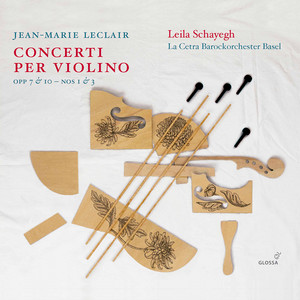 | Violin Concerto in B-Flat Major, Op. 10 No. 1: I. Allegro | Jean-Marie Leclair, Leila Schayegh, La Cetra Barockorchester Basel | A Major | 1 | 11B | 100 BPM |
- ISRC
- DEF057830424
- Label
- L-M Records/RCA Records