- BPM
- 101
- Key
- B♭ Major
- Camelot
- 6B
Serenade for String Orchestra in C Major, Op. 48, TH 48: III. Elégie: Larghetto elegiaco by Pyotr Ilyich Tchaikovsky, Bavarian Radio Symphony Orchestra, Sir Colin Davis Song Details
Pyotr Ilyich Tchaikovsky, Bavarian Radio Symphony Orchestra, Sir Colin Davis's 'Serenade for String Orchestra in C Major, Op. 48, TH 48: III. Elégie: Larghetto elegiaco' had a release date set for January 1, 1988. Since This song is still less than 10 minute long, it is still considered a pretty long duration song compared to the average song length. This song does not appear to be explicit due to the lack of the "E" tag. There are a total of 9 in the song's album "Tchaikovsky: Serenade For Strings / Dvorák: Serenade For Strings". In this album, this song's track order is #3. Furthermore, we believe that the track originated from Netherlands. In terms of popularity, Serenade for String Orchestra in C Major, Op. 48, TH 48: III. Elégie: Larghetto elegiaco is currently not that popular. In our opinion, the overall tone is not very danceable and projects negative sounds, such as being sad, depressed, or angry.
BPM and Tempo
With Serenade for String Orchestra in C Major, Op. 48, TH 48: III. Elégie: Larghetto elegiaco by Pyotr Ilyich Tchaikovsky, Bavarian Radio Symphony Orchestra, Sir Colin Davis having a BPM of 101 with a half-time of 50 BPM and a double-time of 202 BPM, we would consider this track to have a Andante (at a walking pace) tempo marking. Because of this, we believe that the song has an overall slow tempo. The time signature for this track is 3/4.
Music Key
This song has a musical key of B♭ Major. Or for those who are familiar with the camelot wheel, this song has a camelot key of 6B. So, the perfect camelot match for 6B would be either 6B or 7A. While, 7B can give you a low energy boost. For moderate energy boost, you would use 3B and a high energy boost can either be 8B or 1B. Though, if you want a low energy drop, you should looking for songs with either a camelot key of 6A or 5B will give you a low energy drop, 9B would be a moderate one, and 4B or 11B would be a high energy drop. Lastly, 3A allows you to change the mood.
Want to find the BPM and music key for other songs? Check out our BPM and Key Finder page!
- Popularity
- 7%
- Loudness
- -13.242 dB
- Acousticness
- 98%
- Danceability
- 34%
- Energy
- 26%
- Instrumentalness
- 0%
- Liveness
- 15%
- Loudness
- 78%
- Speechiness
- 4%
- Valence
- 32%
Recommendations
| Track | Artist | Key | Energy | Camelot | BPM | ||
|---|---|---|---|---|---|---|---|
 | Csardas: Csardas | Vittorio Monti, Robert Koenig, Si-Qing Lu | D Major | 1 | 10B | 170 BPM | |
 | Peer Gynt Suite No. 1, Op. 46: II. Åse's Death | Edvard Grieg, Wiener Philharmoniker, Zubin Mehta | G Major | 0 | 9B | 99 BPM | |
 | 8 Slavonic Dances, Op.46, B.83: No.1 in C (Presto) | Antonín Dvořák, Czech Philharmonic Orchestra, Jiří Bělohlávek | G Major | 2 | 9B | 106 BPM | |
 | Les saisons (The Seasons), Op. 37b: XI. November: Troika | Ilya Rachkovsky | E Major | 0 | 12B | 74 BPM | |
 | Consolation No. 3 in D-Flat Major, S. 172/3 | Franz Liszt, Vladimir Horowitz | D♭ Major | 0 | 3B | 70 BPM | |
 | Carmen Suite No. 1 (Arr. E. Guiraud): III. Intermezzo | Georges Bizet, Orquestra Simfònica de Barcelona i Nacional de Catalunya, Pablo González | E♭ Major | 0 | 5B | 81 BPM | |
 | Ancient Airs & Dances, Suite III, P. 172: IV. Passacaglia (Roncalli) | Ottorino Respighi, Boston Symphony Orchestra, Seiji Ozawa | G Minor | 3 | 6A | 116 BPM | |
 | Les danses polovtsiennes (Extraits de l'opéra Le Prince Igor): II. Danse des hommes | Alexander Borodin, Anima Eterna, Jos Van Immerseel | A Major | 0 | 11B | 87 BPM | |
 | Piano Concerto No. 2 in F Major, Op. 102: II. Andante | Dmitri Shostakovich, Boris Giltburg, Royal Liverpool Philharmonic Orchestra, Vasily Petrenko | C Minor | 0 | 5A | 80 BPM | |
 | String Quartet No. 8 in C Minor, Op. 110: II. Allegro molto | Dmitri Shostakovich, Borodin Quartet | G Major | 5 | 9B | 126 BPM | |
 | Jazz Suite No. 1: I. Waltz | Dmitri Shostakovich, Russian State Symphony Orchestra, Dmitry Yablonsky | E♭ Major | 1 | 5B | 173 BPM | |
 | Romeo and Juliet, Op. 64: Introduction | Sergei Prokofiev, The Cleveland Orchestra, Lorin Maazel | E Major | 1 | 12B | 112 BPM | |
| Romeo and Juliet, Op. 64 / Act 1: Dance Of The Knights | Sergei Prokofiev, The Cleveland Orchestra, Lorin Maazel | B♭ Major | 6 | 6B | 124 BPM | |
 | Hungarian Rhapsody No. 2, S. 244/2 (Orch. Müller-Berghaus in C Minor) | Franz Liszt, Berliner Philharmoniker, Herbert von Karajan | F Minor | 2 | 4A | 170 BPM | |
 | Souvenir de Florence, Op. 70, TH 118: I. Allegro con spirito - Live from Verbier Festival / 2013 | Pyotr Ilyich Tchaikovsky, Leonidas Kavakos, Lisa Batiashvili, Antoine Tamestit, Blythe Teh Engstroem, Gautier Capuçon, Stephan Koncz | D Major | 2 | 10B | 111 BPM | |
 | Salut d'amour, Op. 12 | Edward Elgar, Sueye Park, Love Derwinger | E Major | 1 | 12B | 83 BPM | |
 | Zdes' khorosho ('How Fair This Spot'), Op. 21, No. 7 | Sergei Rachmaninoff, Pablo Ferrandez, Denis Kozhukhin | A Major | 0 | 11B | 87 BPM | |
 | Don Quixote: Prologue: Entrance of Don Quixote | Ludwig Minkus, Sofia National Opera Orchestra, Nayden Todorov | C Major | 0 | 8B | 124 BPM | |
 | Hungarian Dance No. 1 in G Minor, WoO 1 | Johannes Brahms, Budapest Festival Orchestra, Iván Fischer | G Minor | 2 | 6A | 115 BPM | |
 | Petite suite de concert, Op. 77: III. Un sonnet d'amour | Samuel Coleridge-Taylor, Chicago Sinfonietta, Paul Freeman | A Major | 0 | 11B | 70 BPM | |
 | The Snow Maiden, Op. 12: I. Introduction | Moscow Symphony Orchestra, Moscow Capella, Elena Okolysheva, Arkady Mishenkin, Pyotr Ilyich Tchaikovsky | C Major | 0 | 8B | 91 BPM | |
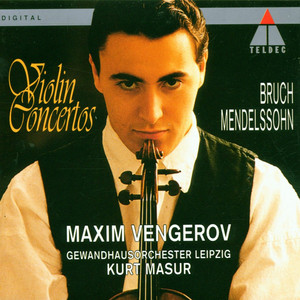 | Bruch : Violin Concerto No.1 in G minor Op.26 : III Finale - Allegro energico | Max Bruch, Maxim Vengerov, Kurt Masur, Gewandhausorchester Leipzig | G Major | 2 | 9B | 90 BPM | |
 | Die Worte des Erlösers am Kreuze, Hob. XX:1: IX. Il Terremoto | Joseph Haydn, Metamorphose String Orchestra, Pavel Lyubomudrov | G Major | 5 | 9B | 155 BPM | |
 | Finlandia, Op. 26 | Jean Sibelius, Berliner Philharmoniker, Herbert von Karajan | A♭ Major | 3 | 4B | 67 BPM | |
 | Polovetsian Dances from Prince Igor: Introduzione | Alexander Borodin, George Szell, The Cleveland Orchestra | A Major | 1 | 11B | 83 BPM |
- ISRC
- NLA508604203
- Label
- L-M Records/RCA Records