- BPM
- 100
- Key
- C Minor
- Camelot
- 5A
String Quartet in E Flat Major, MWV R18: I. Allegro moderato by Felix Mendelssohn, Emerson String Quartet Song Details
"String Quartet in E Flat Major, MWV R18: I. Allegro moderato" by Felix Mendelssohn, Emerson String Quartet had its release date on January 1, 2005. Since This song is still less than 10 minute long, it is still considered a pretty long duration song compared to the average song length. This song does not appear to be explicit due to the lack of the "E" tag. The track order of this song in Felix Mendelssohn, Emerson String Quartet's "Mendelssohn: The String Quartets & Octet In Two Parts" album is number 29 out of 38. On top of that, Germany appears to be the country where this track was created. In terms of popularity, String Quartet in E Flat Major, MWV R18: I. Allegro moderato is currently not that popular. In our opinion, the overall tone is not very danceable and projects negative sounds, such as being sad, depressed, or angry.
BPM and Tempo
We consider the tempo marking of String Quartet in E Flat Major, MWV R18: I. Allegro moderato by Felix Mendelssohn, Emerson String Quartet to be Andante (at a walking pace) because the track has a tempo of 100 BPM, a half-time of 50BPM, and a double-time of 200 BPM. Based on that, the speed of the song's tempo is slow. The time signature for this track is 3/4.
Music Key
C Minor is the music key of this track. Because this track belongs in the C Minor key, the camelot key is 5A. So, the perfect camelot match for 5A would be either 5A or 4B. While, a low energy boost can consist of either 5B or 6A. For moderate energy boost, you would use 2A and a high energy boost can either be 7A or 12A. However, if you are looking for a low energy drop, finding a song with a camelot key of 4A would be a great choice. Where 8A would give you a moderate drop, and 3A or 10A would be a high energy drop. Lastly, 8B allows you to change the mood.
Want to find the BPM and music key for other songs? Check out our BPM and Key Finder page!
- Popularity
- 8%
- Loudness
- -21.367 dB
- Acousticness
- 92%
- Danceability
- 21%
- Energy
- 10%
- Instrumentalness
- 50%
- Liveness
- 14%
- Loudness
- 64%
- Speechiness
- 5%
- Valence
- 10%
Recommendations
| Track | Artist | Key | Energy | Camelot | BPM | ||
|---|---|---|---|---|---|---|---|
 | Etudes-Tableaux, Op. 33, No. 4 in D Minor | Hélène Grimaud | D Minor | 2 | 7A | 94 BPM | |
 | Five pieces for Two Violins and Piano: I. Prelude- Moderato | Dmitri Shostakovich, Brodsky Quartet, Christian Blackshaw | B Minor | 0 | 10A | 82 BPM | |
 | Recueil de chants, Op. 65: No. 6, Barcarolle | Charles-Valentin Alkan, Bruce Liu | G Minor | 0 | 6A | 70 BPM | |
 | Ravel: Sonatine, M. 40: I. Modéré | Maurice Ravel, Bertrand Chamayou | F♯ Minor | 1 | 11A | 67 BPM | |
 | Violin Concerto In E Minor, Op. 64, MWV O14: I. Allegro molto appassionato | Felix Mendelssohn, Anne-Sophie Mutter, Gewandhausorchester, Kurt Masur | E Minor | 1 | 9A | 81 BPM | |
 | Mahler: Blumine | Gustav Mahler, San Francisco Symphony, Michael Tilson Thomas | C Major | 1 | 8B | 100 BPM | |
 | Violin Concerto in D Minor, Op. 47: III. Allegro, ma non tanto | Jean Sibelius, Anne-Sophie Mutter, Staatskapelle Dresden, André Previn | D Major | 2 | 10B | 112 BPM | |
 | Symphony No. 2 In C Minor - "Resurrection" / 1st Movement - Allegro maestoso (Totenfeier): Allegro maestoso | Gustav Mahler, Wiener Philharmoniker, Gilbert Kaplan | C Minor | 1 | 5A | 80 BPM | |
 | Bagatelles, Op. 47, B. 79: No. 3 in G Minor, Allegretto scherzando | Antonín Dvořák, Josef Suk, Miroslav Ambroš, Jiří Bárta, Jan Simon | E♭ Major | 4 | 5B | 91 BPM | |
 | Orfeo ed Euridice, Wq. 30 / Act II: Dance of the Blessed Spirits (Arr. by Mathieu Herzog for Cello and Strings) | Christoph Willibald Gluck, Camille Thomas, Brussels Philharmonic, Mathieu Herzog | B Minor | 1 | 10A | 87 BPM | |
 | Má vlast, JB 1:112: II. Vltava "The Moldau" | Bedřich Smetana, Wiener Philharmoniker, Herbert von Karajan | E Minor | 1 | 9A | 78 BPM | |
 | Dolly Suite, Op. 56: I. Berceuse | Gabriel Fauré, Katia Labèque, Marielle Labèque | E Major | 0 | 12B | 63 BPM | |
 | Paderewski: 6 Humoresques de concert, Op. 14, Cahier I "À l'antique": No. 1, Menuet célèbre | Ignacy Jan Paderewski, Mariam Batsashvili | G Major | 1 | 9B | 106 BPM | |
 | Piano Sonata No. 8 in C minor, Op. 13, "Pathétique": II. Adagio cantabile | Ludwig van Beethoven, Igor Levit | A♭ Major | 0 | 4B | 63 BPM | |
 | String Quartet No. 1 in D Major, Op. 11, TH 111: II. Andante cantabile | Pyotr Ilyich Tchaikovsky, Heath Quartet | A Minor | 1 | 8A | 82 BPM | |
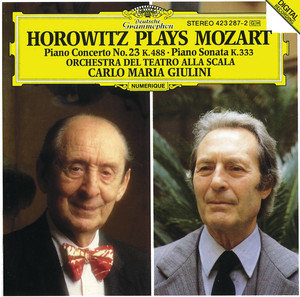 | Piano Concerto No. 23 in A Major, K. 488: I. Allegro (Cadenza by Busoni) | Wolfgang Amadeus Mozart, Vladimir Horowitz, Orchestra Del Teatro Alla Scala, Milano, Carlo Maria Giulini | A Major | 1 | 11B | 140 BPM | |
 | Sonata in D Minor, K. 9 | Domenico Scarlatti, Ivo Pogorelich | D Minor | 0 | 7A | 94 BPM | |
 | Sarasate: Zigeunerweisen, Op. 20 | Pablo de Sarasate, Itzhak Perlman, Abbey Road Ensemble | C Minor | 1 | 5A | 83 BPM | |
 | Romance, Op. 22: No. 1, Andante Molto | Clara Schumann, Carl Schwarz | D♭ Major | 0 | 3B | 136 BPM | |
 | Gluck: Melodie from Orfeo ed Euridice | Christoph Willibald Gluck, Aurélien Pontier | E♭ Major | 2 | 5B | 107 BPM | |
 | Carnaval, Op. 9: No. 12, Chopin | Robert Schumann, Boris Giltburg | B♭ Minor | 0 | 3A | 92 BPM | |
 | 4 Impromptus, D. 899 (Op. 90): No. 4 in A-Flat Major. Allegretto | Franz Schubert, Radu Lupu | A♭ Major | 0 | 4B | 125 BPM | |
 | Piano Sonata No. 23 in F Minor, Op. 57 "Appassionata": 2. Andante con moto | Ludwig van Beethoven, Daniel Barenboim | D♭ Major | 0 | 3B | 170 BPM | |
 | 13 Pieces, Op. 76: No. 3 Carillon | Jean Sibelius, Håvard Gimse | F Major | 0 | 7B | 72 BPM | |
 | In the Steppes of Central Asia | Alexander Borodin, Royal Philharmonic Orchestra, Vladimir Ashkenazy | A Major | 0 | 11B | 69 BPM |
- ISRC
- DEN960400861
- Label
- L-M Records/RCA Records