- BPM
- 69
- Key
- D Major
- Camelot
- 10B
Allegro by Collegium Aureum Song Details
"Allegro" by Collegium Aureum had its release date on 1966. With this song being about 5 minutes long, at This song is fairly a long song compared to the average song length. This song does not have an "Explicit" tag, making it safe for all ages. The song is number 8 out of 18 in Corelli, Tartini, Pez, Manfredini - Weihnachtskonzerte by Collegium Aureum. Going off of the ISRC code of this track, we detected that the origin of this track is from Germany. Allegro is not that popular right now. In our opinion, the overall tone is not very danceable and projects negative sounds, such as being sad, depressed, or angry.
BPM and Tempo
The tempo marking of Allegro by Collegium Aureum is Adagio (slowly with great expression), since this song has a tempo of 69 BPM. With that information, we can conclude that the song has a slow tempo. The time signature for this track is 4/4.
Music Key
D Major is the music key of this track. This also means that this song has a camelot key of 10B. So, the perfect camelot match for 10B would be either 10B or 11A. While, 11B can give you a low energy boost. For moderate energy boost, you would use 7B and a high energy boost can either be 12B or 5B. Though, if you want a low energy drop, you should looking for songs with either a camelot key of 10A or 9B will give you a low energy drop, 1B would be a moderate one, and 8B or 3B would be a high energy drop. Lastly, 7A allows you to change the mood.
Want to find the BPM and music key for other songs? Check out our BPM and Key Finder page!
- Popularity
- 4%
- Loudness
- -14.705 dB
- Acousticness
- 79%
- Danceability
- 17%
- Energy
- 19%
- Instrumentalness
- 73%
- Liveness
- 18%
- Loudness
- 75%
- Speechiness
- 5%
- Valence
- 12%
Recommendations
| Track | Artist | Key | Energy | Camelot | BPM | ||
|---|---|---|---|---|---|---|---|
 | Sonata in A Minor, QV 2:41a/b: IV. Allegro | Johann Joachim Quantz, Ensemble Zefiro, Alfredo Bernardini | F♯ Minor | 3 | 11A | 105 BPM | |
 | Concerto Grosso in D Major, Op. 3, No. 1: III. Adagio | Francesco Geminiani, Capella Istropolitana, Jaroslav Krcek | B Minor | 1 | 10A | 114 BPM | |
 | Su le sponde del Tebro: Sinfonia | Alessandro Scarlatti, Ruth Ziesak, Reinhold Friedrich, Budapest Strings, Karoly Botvay | D Major | 1 | 10B | 130 BPM | |
 | Concerto a 5 in A ,Op. 9, No. 4 for Violin, Strings, and Continuo - Rev. Giegling: 2. Adagio | Tomaso Albinoni, Felix Ayo, I Musici, Maria Teresa Garatti | F Major | 2 | 7B | 104 BPM | |
 | Cello Concerto in G Major, G. 480: III. Allegro | Luigi Boccherini, Tim Hugh, Scottish Chamber Orchestra, Anthony Halstead | E Minor | 1 | 9A | 96 BPM | |
 | Concerto Grosso in C Minor, Op. 3, No. 11: III. Allegro | Francesco Onofrio Manfredini, Capella Istropolitana, Jaroslav Krcek | C Minor | 1 | 5A | 120 BPM | |
 | フルート、シャリュモー、オーボエと2台のコントラバスのための協奏曲 ト長調 Iii- Presto | ゲオルク・フィリップ・テレマン, 有田正広, ラ・ストラヴァガンツァ・ケルン, ペーター・ヴェスターマン, デイン・ロバーツ, デイヴィッド・シンクレア, エリック・ヘープリッチ | D Major | 1 | 10B | 67 BPM | |
 | Overture in G Minor: III. Aria. Presto | Giuseppe Antonio Brescianello, La Cetra Barockorchester Basel, David Plantier, Vaclav Luks | A Minor | 1 | 8A | 67 BPM | |
 | Oboe d'amore Concerto in D Major: IV. Allegro non troppo | Christoph Graupner, Lajos Lencsés, Budapest Strings, Karoly Botvay | C Major | 1 | 8B | 111 BPM | |
 | Concerto for Flute and Oboe in G Major, FWV L:G8: III. Allegro | Johann Friedrich Fasch, Gunther Holler, Helmut Hucke, Cappella Coloniensis, Hans-Martin Linde | E♭ Minor | 2 | 2A | 127 BPM | |
 | Ottavo libro de' madrigali (Madrigali guerrieri, et amorosi ...), Venice, 1638 - If my Celia could persuade | Claudio Monteverdi, Alfred Deller, Deller Consort | F Minor | 3 | 4A | 92 BPM | |
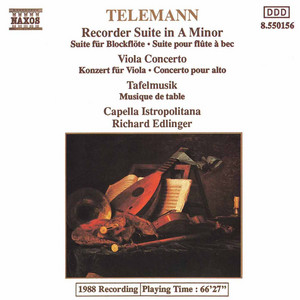 | Overture (Suite) In A Minor, TWV 55:a2: V. Rejouissance | Jiří Stivín, Capella Istropolitana, Georg Philipp Telemann | E Minor | 1 | 9A | 123 BPM | |
 | Albinoni: Oboe Concerto in D Major, Op. 7 No. 6: I. Allegro | Tomaso Albinoni, Sidney Sutcliffe/Virtuosi of England/Arthur Davison, Arthur Davison, Virtuosi Of England | D Major | 3 | 10B | 105 BPM | |
 | Concerto Grosso No. 3 in F Major: V. Allegro | Alessandro Scarlatti, Capella Istropolitana, Jaroslav Krcek | F Major | 2 | 7B | 136 BPM | |
 | La Serva Padrona: Aspettare, e non venire | Giovanni Battista Pergolesi, Collegium Aureum | B♭ Major | 1 | 6B | 116 BPM | |
 | Pavana - Galliarda | Melchior Franck, Collegium Aureum | G Major | 1 | 9B | 176 BPM | |
 | Symphony in G Major, Op. 3 No. 1, WolS G2: IV. Presto | Johann Stamitz, Musica Viva, Alexander Rudin | A Major | 2 | 11B | 111 BPM | |
 | FANFARE (MASTERPIECE THEATRE THEME) | Collegium Aureum | F♯ Major | 4 | 2B | 172 BPM | |
 | Symphony No. 2 in D Major: II. Adagio ma non molto | William Herschel, Matthias Bamert, London Mozart Players | D Major | 1 | 10B | 126 BPM | |
 | Concerto a 4 in C Minor, Op. 7, No. 4: III. Adagio | Henricus Albicastro, Collegium Marianum, Collegium 1704, Vaclav Luks | D Major | 1 | 10B | 95 BPM | |
 | Vesperae solennes de confessore, K. 339: Laudate pueri | Wolfgang Amadeus Mozart, Collegium Aureum, Franzjosef Maier | B♭ Major | 3 | 6B | 61 BPM | |
 | Symphony in D Minor, J-C 23: III. Presto | Giovanni Battista Sammartini, Aradia Ensemble, Kevin Mallon | D♭ Major | 1 | 3B | 131 BPM | |
 | Symphony No. 83 in G Minor, Hob.I:83, "La Poule": IV. Finale. Vivace | Joseph Haydn, Collegium Aureum, Franzjosef Maier | G Major | 1 | 9B | 75 BPM | |
 | Concerto in E Major for Flute, Oboe d’Amore and Violin, TWV 53:E1: I. Andante | Georg Philipp Telemann, I Solisti di Zagreb, André Lardrot, Antonio Janigro, Raymond Meylan, Jelka Stanic | G Major | 3 | 9B | 115 BPM | |
| Concerto for Flute and Oboe in G Major, FWV L:G8: I. Allegro | Johann Friedrich Fasch, Gunther Holler, Helmut Hucke, Cappella Coloniensis, Hans-Martin Linde | D♭ Major | 3 | 3B | 112 BPM |
- ISRC
- DEE476600152
- Label
- L-M Records/RCA Records