- BPM
- 125
- Key
- A Major
- Camelot
- 11B
La source, ou Naila: Suite No. 3: La Source: Intermezzo (Pas des Fleurs, Grande Valse) by Léo Delibes, Slovak Radio Symphony Orchestra, Andrew Mogrelia Song Details
"La source, ou Naila: Suite No. 3: La Source: Intermezzo (Pas des Fleurs, Grande Valse)" by Léo Delibes, Slovak Radio Symphony Orchestra, Andrew Mogrelia had its release date on December 13, 1995. With this song being around four minutes long, at 3:43, the duration of this song is pretty average compared to other songs. This track is safe for children and doesn't appear to contain any foul language, since the "Explicit" tag was not present in this track. The song is number 16 out of 43 in Delibes: Coppelia (Complete Ballet) / La Source Suites by Léo Delibes. Going off of the ISRC code of this track, we detected that the origin of this track is from Hong Kong. Based on our statistics, La source, ou Naila: Suite No. 3: La Source: Intermezzo (Pas des Fleurs, Grande Valse)'s popularity is not that popular right now. In our opinion, the overall tone is not very danceable and projects negative sounds, such as being sad, depressed, or angry.
BPM and Tempo
The tempo marking of La source, ou Naila: Suite No. 3: La Source: Intermezzo (Pas des Fleurs, Grande Valse) by Léo Delibes, Slovak Radio Symphony Orchestra, Andrew Mogrelia is Allegro (fast, quick, and bright), since this song has a tempo of 125 BPM. With that information, we can conclude that the song has a fast tempo. This song can go great with walking. The time signature for this track is 4/4.
Music Key
This song is in the music key of A Major. This also means that this song has a camelot key of 11B. So, the perfect camelot match for 11B would be either 11B or 12A. While, 12B can give you a low energy boost. For moderate energy boost, you would use 8B and a high energy boost can either be 1B or 6B. Though, if you want a low energy drop, you should looking for songs with either a camelot key of 11A or 10B will give you a low energy drop, 2B would be a moderate one, and 9B or 4B would be a high energy drop. Lastly, 8A allows you to change the mood.
Want to find the BPM and music key for other songs? Check out our BPM and Key Finder page!
- Popularity
- 11%
- Loudness
- -32.362 dB
- Acousticness
- 83%
- Danceability
- 22%
- Energy
- 1%
- Instrumentalness
- 12%
- Liveness
- 21%
- Loudness
- 46%
- Speechiness
- 5%
- Valence
- 8%
Recommendations
| Track | Artist | Key | Energy | Camelot | BPM | ||
|---|---|---|---|---|---|---|---|
 | Giselle: Act I: Retour de la vendange et valse (The Grape-Pickers Return) | Adolphe Adam, Slovak Radio Symphony Orchestra, Andrew Mogrelia | D Major | 0 | 10B | 134 BPM | |
 | Roma, WD 37: IV. Allegro vivacissimo | Georges Bizet, Jean-Luc Tingaud, RTÉ National Symphony Orchestra | C Major | 1 | 8B | 172 BPM | |
 | Act III. Spanish dance | Moscow New Philharmonic Orchestra, Vladimir Ponkin | F♯ Minor | 2 | 11A | 119 BPM | |
 | Carmen Suite: VIII. Bolero (after G. Bizet): Changing of the Guard | Rodion Shchedrin, Ukrainian State Symphony Orchestra, Theodore Kuchar | G Major | 1 | 9B | 114 BPM | |
 | Carmen Suite No. 2 (Arr. E. Guiraud): V. La garde montante | Georges Bizet, Orquestra Simfònica de Barcelona i Nacional de Catalunya, Pablo González | D Minor | 0 | 7A | 117 BPM | |
| Act III. Neopolitan dance | Moscow New Philharmonic Orchestra, Vladimir Ponkin | D Major | 3 | 10B | 143 BPM | |
![21 Hungarian Dances, WoO 1: Hungarian Dance No. 14 (orch. Parlow) [Version for orchestra] by Johannes Brahms, Budapest Symphony Orchestra, Istvan Bogar](https://i.scdn.co/image/ab67616d00001e02b40cf153157e413e7ebd79c5) | 21 Hungarian Dances, WoO 1: Hungarian Dance No. 14 (orch. Parlow) [Version for orchestra] | Johannes Brahms, Budapest Symphony Orchestra, Istvan Bogar | E Minor | 1 | 9A | 81 BPM | |
 | Peer Gynt Suite No. 1, Op. 46: III. Anitra's Dance. Tempo di mazurka - 2017 Remastered Version | Edvard Grieg, Leonard Bernstein, New York Philharmonic | F Major | 2 | 7B | 80 BPM | |
 | Paquita: Polonaise and Mazurka | Ludwig Minkus, Anna Takova-Baynova, Valentina Raicheva, Sofia National Opera Orchestra, Boris Spassov | B♭ Major | 4 | 6B | 124 BPM | |
 | Raymonda, Act II: Grand pas Espagnol | Alexander Glazunov, Kivov Orchestra, Viktor Fedotov | E♭ Major | 3 | 5B | 95 BPM | |
 | Don Quixote: Act I: Street Dancer | Ludwig Minkus, Sofia National Opera Orchestra, Nayden Todorov | D Major | 0 | 10B | 100 BPM | |
 | II. Contredanse | Dmitri Shostakovich, Ukraine National Symphony Orchestra, Theodore Kuchar | G Major | 0 | 9B | 63 BPM | |
 | Jeu d'Esprit, Polka, Op. 196 | Émile Waldteufel, Slovak State Philharmonic Orchestra, Kosice, Alfred Walter | D Major | 4 | 10B | 174 BPM | |
 | Scottish Rhapsody | Ronald Binge, Slovak Radio Symphony Orchestra, Ernest Tomlinson | D♭ Major | 2 | 3B | 142 BPM | |
 | Lyric Suite, Op. 54: III. Notturno (Nocturne): Andante | Edvard Grieg, Bergen Philharmonic Orchestra, Ole Kristian Ruud | F Major | 0 | 7B | 82 BPM | |
 | Le Corsaire: Pas d Esclave - Coda | Prince Pyotr Von Oldenburg, English National Ballet Philharmonic, Gavin Sutherland | E Major | 1 | 12B | 143 BPM | |
 | Friska from Hungarian Rhapsody No. 2 | Franz Liszt, Zubin Mehta, Israel Philharmonic Orchestra | G Major | 2 | 9B | 78 BPM | |
 | Slavonic Dances, Series I, B. 83: No. 2 in E Minor, Dumka. Allegretto scherzando | Antonín Dvořák, Czech Philharmonic, Sir Simon Rattle | A♭ Major | 0 | 4B | 133 BPM | |
 | La Bayadere, Act III: 46. "Variation - 3rd Soloist Shade" | Evergreen Symphony Orchestra, Kevin Galiè | D Major | 0 | 10B | 170 BPM | |
 | Cinderella, Op. 87: Act I: No. 19. Cinderella's Departure for the Ball | Sergei Prokofiev, Gennady Rozhdestvensky, Moscow RTV Symphony Orchestra | D♭ Major | 0 | 3B | 60 BPM | |
 | Der Zigeunerbaron: Overture | Johann Strauss II, Hallé, Bramwell Tovey | C Major | 0 | 8B | 77 BPM | |
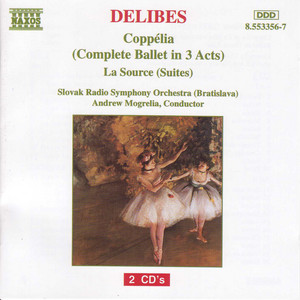 | Coppelia: Act III - Le travail | Léo Delibes, Slovak Radio Symphony Orchestra, Andrew Mogrelia | G Minor | 0 | 6A | 159 BPM | |
 | Symphony No. 1, GMW 11: IIb. Trio. Recht gemächlich | Gustav Mahler, Tonhalle-Orchester Zürich, Paavo Järvi | F Major | 0 | 7B | 113 BPM | |
 | Etudes: XII. Mazurka | Knudåge Riisager, Gennady Rozhdestvensky, Danish National Symphony Orchestra | A Minor | 3 | 8A | 141 BPM | |
 | Khachaturian : Gayaneh Suite No.1 : II Dance of the Young Maidens | Aram Khachaturian, Alexander Lazarev, The Bolshoi Symphony Orchestra | E Minor | 1 | 9A | 114 BPM |
- ISRC
- HKI199494316
- Label
- L-M Records/RCA Records