- BPM
- 88
- Key
- E♭ Major
- Camelot
- 5B
Quatuor No. 6 in E Minor: II. Gai by Christophe Rousset, Masahiro Arita, Ryo Terakado, Kaori Uemura Song Details
Christophe Rousset, Masahiro Arita, Ryo Terakado, Kaori Uemura's 'Quatuor No. 6 in E Minor: II. Gai' had a release date set for January 1, 2010. The duration of This song is about two minutes long, specifically at 2:36. This song does not appear to have any foul language. Quatuor No. 6 in E Minor: II. Gai's duration is considered a little bit shorter than the average duration of a typical track. There are a total of 37 in the song's album "Telemann: Quatuors Parisiens". In this album, this song's track order is #14. Quatuor No. 6 in E Minor: II. Gai is not that popular right now. In our opinion, the overall tone is not very danceable and projects negative sounds, such as being sad, depressed, or angry.
BPM and Tempo
With Quatuor No. 6 in E Minor: II. Gai by Christophe Rousset, Masahiro Arita, Ryo Terakado, Kaori Uemura having a BPM of 88 with a half-time of 44 BPM and a double-time of 176 BPM, we would consider this track to have a Andante (at a walking pace) tempo marking. Because of this, we believe that the song has an overall slow tempo. Looking at the BPM of this song, this song might go great with yoga or pilates. The time signature for this track is 3/4.
Music Key
E♭ Major is the music key of this track. Or for those who are familiar with the camelot wheel, this song has a camelot key of 5B. So, the perfect camelot match for 5B would be either 5B or 6A. While, 6B can give you a low energy boost. For moderate energy boost, you would use 2B and a high energy boost can either be 7B or 12B. Though, if you want a low energy drop, you should looking for songs with either a camelot key of 5A or 4B will give you a low energy drop, 8B would be a moderate one, and 3B or 10B would be a high energy drop. Lastly, 2A allows you to change the mood.
Want to find the BPM and music key for other songs? Check out our BPM and Key Finder page!
- Popularity
- 12%
- Loudness
- -22.992 dB
- Acousticness
- 88%
- Danceability
- 32%
- Energy
- 3%
- Instrumentalness
- 0%
- Liveness
- 8%
- Loudness
- 62%
- Speechiness
- 4%
- Valence
- 39%
Recommendations
| Track | Artist | Key | Energy | Camelot | BPM | ||
|---|---|---|---|---|---|---|---|
 | Symphony in C Major, J-C 4: II. Andante e affettuoso | Giovanni Battista Sammartini, Aradia Ensemble, Kevin Mallon | F♯ Major | 1 | 2B | 137 BPM | |
 | Sonata in D Minor, Op. 2, No. 2: III. Largo | Benedetto Marcello, Dan Laurin, Parnassus Avenue | E Major | 0 | 12B | 78 BPM | |
 | King Arthur, Z. 628, First Music: Overture | Henry Purcell, Vox Luminis, Lionel Meunier | D♭ Major | 3 | 3B | 117 BPM | |
 | Concerto for Violoncello, Strings and Basso Continuo in A Minor, RV 418: I. Allegro | Antonio Vivaldi, Anner Bylsma, Tafelmusik Baroque Orchestra, Jeanne Lamon | E Major | 2 | 12B | 135 BPM | |
 | Soft Music on the Rocks | Henry Purcell, Musicians Of The Globe, Philip Pickett | F♯ Minor | 0 | 11A | 81 BPM | |
 | Cello Sonata in F Major, Op. 1, No. 1: I. Largo | Benedetto Marcello, Collegium Pro Musica | B Major | 1 | 1B | 77 BPM | |
 | Sonata for Recorder and Bassoon in A Minor, RV 86: II. Allegro | Antonio Vivaldi, Giorgio Tabacco, L'astrée | A♭ Minor | 2 | 1A | 175 BPM | |
 | Concerto a violono e viola da gamba in C Minor, GraunWV A:XIII:3: III. Allegro | Johann Gottlieb Graun, Ensemble Baroque De Limoges, Christophe Coin, Gilles Colliard | B Minor | 2 | 10A | 120 BPM | |
 | Violin Sonata in G Major, Op. 5, No. 12: III. Largo | Jean-Marie Leclair, Trio Settecento | D Minor | 1 | 7A | 105 BPM | |
 | Concerto grosso No. 3 in D Minor: IV. Allegro (After D. Scarlatti) | Charles Avison, Avison Ensemble, Pavlo Beznosiuk | F Major | 1 | 7B | 74 BPM | |
 | Trumpet Concerto in D Major, G. 28: V. Allegro | Giuseppe Torelli, Niklas Eklund, Wasa Baroque Ensemble, Edward Tarr | G Major | 2 | 9B | 115 BPM | |
 | 12 Sonate melodiche, G major, TWV41: G 4: II. Vivace | Han De Vries, Wouter Moeller | F♯ Major | 3 | 2B | 99 BPM | |
 | Concerto in C major for violoncello piccolo, strings and b.c.: Allegro | Giovanni Battista Sammartini, Camerata Köln | F♯ Major | 2 | 2B | 133 BPM | |
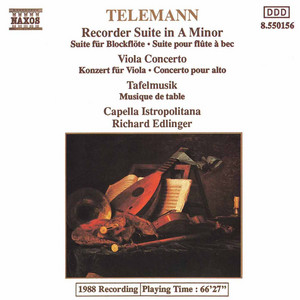 | Overture (Suite) In A Minor, TWV 55:a2: V. Rejouissance | Jiří Stivín, Capella Istropolitana, Georg Philipp Telemann | E Minor | 1 | 9A | 123 BPM | |
 | Concerto a cinque No. 9, Op. 7: III. Allegro | Tomaso Albinoni, Paul Dombrecht, Il Fondamento | E Major | 3 | 12B | 120 BPM | |
 | Concerto Decimo Con L'Eco, B Dur: II. Larghetto | Alessandro Marcello, Venice Baroque Orchestra | E Major | 0 | 12B | 85 BPM | |
 | Concerto for 2 Flutes and Lute in E Minor, TWV 53:E2: II. Presto | Georg Philipp Telemann, Gunther Holler, Christoph Huntgeburth, Cappella Coloniensis, Hans-Martin Linde | E♭ Minor | 2 | 2A | 126 BPM | |
 | Concerto for 3 Trumpets, Timpani, 2 Oboes, bassoon and Violin in D Major, FWV L:D3: I. Allegro | Johann Friedrich Fasch, Il Gardellino | A♭ Major | 2 | 4B | 99 BPM | |
| Concerto a cinque No. 8, Op. 9: I. Allegro | Tomaso Albinoni, Paul Dombrecht, Il Fondamento | F♯ Minor | 3 | 11A | 111 BPM | |
 | Konzert für Oboe Nr. 3 g-Moll, HWV 287: IV. Allegro | George Frideric Handel, Marcel Ponseele, Il Gardellino | D♭ Minor | 2 | 12A | 118 BPM | |
 | Concerto Grosso in C Minor, Op. 3, No. 11: III. Allegro | Francesco Onofrio Manfredini, Capella Istropolitana, Jaroslav Krcek | C Minor | 1 | 5A | 120 BPM | |
 | Symphony No. 8 in D Minor, Op. 2, "Worcester Overture": I. Pomposo - Allegro | William Boyce, Aradia Ensemble, Kevin Mallon | A♭ Major | 1 | 4B | 72 BPM | |
 | Concert Royal No. 4 in E minor: 4. Courante a l'italienne (Gayement. Pointé-coulé) | François Couperin, Irena Grafenauer, Brigitte Engelhard, Philharmonisches Duo Berlin | D Major | 4 | 10B | 109 BPM | |
 | Violin Sonata in E-flat Major: III. Allegro assai | Franz Benda, Georg Kallweit, Berliner Barock Compagney | F♯ Major | 1 | 2B | 139 BPM | |
 | Les Boréades, RCT 31: Entrée de Polymnie (Arr. for Baroque Ensemble & Saxophone by Bo Wiget) | Jean-Philippe Rameau, Lautten Compagney, Asya Fateyeva, Wolfgang Katschner | F Major | 1 | 7B | 101 BPM |
- ISRC
- This song does not have an ISRC.
- Label
- L-M Records/RCA Records