- BPM
- 142
- Key
- G Major
- Camelot
- 9B
Pavane pour une infante défunte, M. 19 (Orchestral Version) by Maurice Ravel, Academy of St. Martin in the Fields, Sir Neville Marriner Song Details
"Pavane pour une infante défunte, M. 19 (Orchestral Version)" by Maurice Ravel, Academy of St. Martin in the Fields, Sir Neville Marriner had its release date on January 1, 1995. This song is about six minutes long, preciously at 6:28, making this song fairly long compared to other songs. The song is number 11 out of 11 in Fauré: Requiem / Koechlin: Choral sur le nom de Fauré by Sylvia McNair, Thomas Allen, Academy of St. Martin in the Fields Chorus, Academy of St. Martin in the Fields, John Birch, Sir Neville Marriner. Going off of the ISRC code of this track, we detected that the origin of this track is from Netherlands. Based on our statistics, Pavane pour une infante défunte, M. 19 (Orchestral Version)'s popularity is below average in popularity right now. In our opinion, the overall tone is not very danceable and projects negative sounds, such as being sad, depressed, or angry.
BPM and Tempo
The tempo marking of Pavane pour une infante défunte, M. 19 (Orchestral Version) by Maurice Ravel, Academy of St. Martin in the Fields, Sir Neville Marriner is Allegro (fast, quick, and bright), since this song has a tempo of 142 BPM. With that information, we can conclude that the song has a fast tempo. This song can go great with jogging or cycling. The time signature for this track is 3/4.
Music Key
This song is in the music key of G Major. This also means that this song has a camelot key of 9B. So, the perfect camelot match for 9B would be either 9B or 10A. While, 10B can give you a low energy boost. For moderate energy boost, you would use 6B and a high energy boost can either be 11B or 4B. Though, if you want a low energy drop, you should looking for songs with either a camelot key of 9A or 8B will give you a low energy drop, 12B would be a moderate one, and 7B or 2B would be a high energy drop. Lastly, 6A allows you to change the mood.
Want to find the BPM and music key for other songs? Check out our BPM and Key Finder page!
- Popularity
- 27%
- Loudness
- -30.747 dB
- Acousticness
- 98%
- Danceability
- 14%
- Energy
- 3%
- Instrumentalness
- 95%
- Liveness
- 6%
- Loudness
- 49%
- Speechiness
- 4%
- Valence
- 4%
Recommendations
| Track | Artist | Key | Energy | Camelot | BPM | ||
|---|---|---|---|---|---|---|---|
 | Dvorák / Transc. Lenaerts: Rusalka, Op. 114, Act 1: Song to the Moon | Antonín Dvořák, Anneleen Lenaerts | F♯ Major | 0 | 2B | 168 BPM | |
 | Le Sacre du Printemps - Revised version for Orchestra (published 1947) / Part 1: The Adoration of the Earth: Introduction | Igor Stravinsky, Berliner Philharmoniker, Herbert von Karajan | G Major | 0 | 9B | 69 BPM | |
 | Sospiri, Op. 70 | Edward Elgar, Academy of St. Martin in the Fields, Sir Neville Marriner | F Major | 1 | 7B | 177 BPM | |
 | Symphony No. 5 In C Sharp Minor: 4. Adagietto (Sehr langsam) | Gustav Mahler, Gyeonggi Philharmonic Orchestra, Shi-Yeon Sung | F Major | 0 | 7B | 82 BPM | |
 | Fontane di Roma, P. 106: I. La fontana di Valle Giulia all'alba | Ottorino Respighi, New York Philharmonic, Giuseppe Sinopoli | F♯ Major | 2 | 2B | 73 BPM | |
 | Les jeux d'eau à la Villa d'Este | Franz Liszt, André Watts | F♯ Major | 0 | 2B | 72 BPM | |
 | Ma mère l'oye, M. 60 (Version for Orchestra): V. Le jardin féerique | Maurice Ravel, The Prague Festival Orchestra, Pavel Urbanek | C Major | 0 | 8B | 89 BPM | |
 | Lyric Pieces, Book 5, Op. 54: Nocturne | Edvard Grieg, Alessio Bax | C Major | 0 | 8B | 72 BPM | |
 | Valses nobles et sentimentales, M.61: 2. Assez lent - avec une expression intense | Maurice Ravel, Cleveland Orchestra, Pierre Boulez | G Minor | 0 | 6A | 80 BPM | |
 | Nocturnes, Op. 27: No. 2 in D-Flat Major | Frédéric Chopin, Arthur Rubinstein | D♭ Major | 0 | 3B | 77 BPM | |
 | Myrthen, Op. 25 - Version for Cello and Piano: XXIV. Du bist wie eine Blume | Robert Schumann, Kian Soltani, Aaron Pilsan | F Major | 0 | 7B | 116 BPM | |
 | Also sprach Zarathustra, Op. 30: II. Von den Hinterweltlern | Richard Strauss, Berliner Philharmoniker, Herbert von Karajan | A♭ Major | 0 | 4B | 78 BPM | |
 | The Planets, Op. 32: II. Venus, the Bringer of Peace | Gustav Holst, Lorin Maazel, L'Orchestre National de France, Orchestre National De France | A♭ Major | 0 | 4B | 139 BPM | |
 | Serenade in C Major, Op. 48: I. Pezzo in forma di Sonatina | Pyotr Ilyich Tchaikovsky, Vienna Chamber Orchestra, Philippe Entremont | C Major | 3 | 8B | 112 BPM | |
 | Piano Concerto in F-Sharp Minor, Op. 20: II. Andante | Alexander Scriabin, Konstantin Scherbakov, Moscow Philharmonic Orchestra, Igor Golovschin | E♭ Major | 0 | 5B | 81 BPM | |
 | Liebestraume, S541/R211 : No. 3: Nocturne in A-Flat Major | Franz Liszt, Jenő Jandó | A♭ Major | 0 | 4B | 60 BPM | |
 | Five Variants of "Dives and Lazarus" | Ralph Vaughan Williams, Iona Brown, Kenneth Heath, Skaila Kanga, Academy of St. Martin in the Fields, Sir Neville Marriner | B Minor | 1 | 10A | 87 BPM | |
 | Lyric Pieces, Book VI, Op. 57: No. 6, Hjemve. Andante | Edvard Grieg, Javier Perianes | E Minor | 0 | 9A | 166 BPM | |
 | Rhapsody on a Theme of Paganini, Op. 43: Variation 18 | Sergei Rachmaninoff, Bernd Glemser, Polish National Radio Symphony Orchestra, Antoni Wit | D♭ Major | 1 | 3B | 76 BPM | |
 | Piano Concerto No. 2 in F Major, Op. 102: II. Andante | Dmitri Shostakovich, Boris Giltburg, Royal Liverpool Philharmonic Orchestra, Vasily Petrenko | C Minor | 0 | 5A | 80 BPM | |
 | Capriccio brillant, Op. 22: Andante | Felix Mendelssohn, Matthias Kirschnereit, Michael Sanderling, Frankfurt Radio Symphony Orchestra | B Major | 0 | 1B | 91 BPM | |
 | Schoenberg: Verklärte Nacht, Op. 4: V. Adagio, molto tranquilo | Arnold Schoenberg, Daniel Barenboim, Chicago Symphony Orchestra, Charles Pikler, John Sharp, Joseph Golan, Li-Kuo Chang, Ruben Gonzalez, Stephen Balderston | E Minor | 1 | 9A | 125 BPM | |
 | Young Birches, Op. 128, No. 2 | Amy Beach, Joanne Polk | F♯ Minor | 1 | 11A | 170 BPM | |
 | Scottish Fantasy for Violin and Orchestra, Op. 46: I. Introduction: Grave, Adagio cantabile | Max Bruch, Joshua Bell, Academy of St. Martin in the Fields | E♭ Major | 2 | 5B | 60 BPM | |
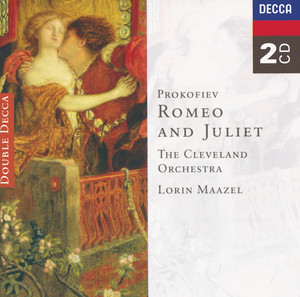 | Romeo and Juliet, Op. 64: Introduction | Sergei Prokofiev, The Cleveland Orchestra, Lorin Maazel | E Major | 1 | 12B | 112 BPM |
- ISRC
- NLA509300012
- Label
- L-M Records/RCA Records