- BPM
- 101
- Key
- F♯ Minor
- Camelot
- 11A
Trio No. 27 in D Major: Allegro di molto by Franz Joseph Haydn, Netherlands Baryton Trio Song Details
On January 1, 2000, the song "Trio No. 27 in D Major: Allegro di molto" was released by Franz Joseph Haydn, Netherlands Baryton Trio. The duration of This song is about two minutes long, specifically at 2:23. This song does not appear to have any foul language. Trio No. 27 in D Major: Allegro di molto's duration is considered a little bit shorter than the average duration of a typical track. The track order of this song in Franz Joseph Haydn, Netherlands Baryton Trio's "Haydn: Baryton Trios" album is number 15 out of 19. On top of that, France appears to be the country where this track was created. In terms of popularity, Trio No. 27 in D Major: Allegro di molto is currently unknown. The mood doesn't appear to be that danceable, but it still produces a high amount of positive energy.
BPM and Tempo
We consider the tempo marking of Trio No. 27 in D Major: Allegro di molto by Franz Joseph Haydn, Netherlands Baryton Trio to be Andante (at a walking pace) because the track has a tempo of 101 BPM, a half-time of 50BPM, and a double-time of 202 BPM. Based on that, the speed of the song's tempo is slow. The time signature for this track is 3/4.
Music Key
F♯ Minor is the music key of this track. This also means that this song has a camelot key of 11A. So, the perfect camelot match for 11A would be either 11A or 10B. While, a low energy boost can consist of either 11B or 12A. For moderate energy boost, you would use 8A and a high energy boost can either be 1A or 6A. However, if you are looking for a low energy drop, finding a song with a camelot key of 10A would be a great choice. Where 2A would give you a moderate drop, and 9A or 4A would be a high energy drop. Lastly, 2B allows you to change the mood.
Want to find the BPM and music key for other songs? Check out our BPM and Key Finder page!
- Popularity
- 0%
- Loudness
- -13.419 dB
- Acousticness
- 93%
- Danceability
- 35%
- Energy
- 48%
- Instrumentalness
- 89%
- Liveness
- 22%
- Loudness
- 78%
- Speechiness
- 8%
- Valence
- 82%
Recommendations
| Track | Artist | Key | Energy | Camelot | BPM | ||
|---|---|---|---|---|---|---|---|
 | Piano Trio in G, H.XIV No. 6/H.XVI No. 6: 2. Adagio | Joseph Haydn, Beaux Arts Trio | B♭ Major | 1 | 6B | 91 BPM | |
 | String Quartet in D Major, Op. 44, No. 1: III. Andante espressivo ma con moto | Felix Mendelssohn, Cecilia String Quartet | F Major | 2 | 7B | 81 BPM | |
 | Piano Concerto No. 4 in G Minor: I. Allegro | Giovanni Paisiello, Francesco Nicolosi, Collegium Philarmonicum Chamber Orchestra, Gennaro Cappabianca | E♭ Major | 2 | 5B | 135 BPM | |
 | Concerto pour Violoncelle, Cordes et Clavecin en Sol Mineur: II. Adagio | Georg Matthias Monn, Jean-Guihen Queyras, Freiburger Barockorchester, Petra Mullejans | E♭ Major | 1 | 5B | 86 BPM | |
 | Serenade in D Major, LMV VIII:9: VI. Adagio | Leopold Mozart, Fabrice Millischer, Bayerische Kammerphilharmonie, Reinhard Goebel | G Major | 1 | 9B | 100 BPM | |
 | Arcangelo Corelli: Sonata for violin & continuo in F major, Op. 5/10 (Giga) | Arcangelo Corelli, I Solisti di Zagreb, Antonio Janigro | G Major | 3 | 9B | 115 BPM | |
 | Sinfonia "Il girono onomastico": I. Allegro, quasi presto | Antonio Salieri, Matthias Bamert, London Mozart Players | D Major | 0 | 10B | 140 BPM | |
 | Symphony No. 1 in E Major: II. Andantino | John Abraham Fisher, Czech Philharmonic Chamber Orchestra, Petra Žďárská, Michael Halasz | A Major | 0 | 11B | 112 BPM | |
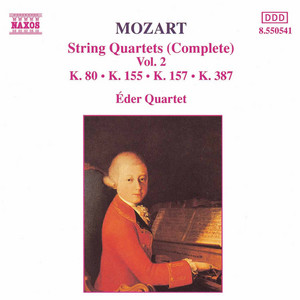 | String Quartet No. 4 in C Major, K. 157: II. Andante | Eder Quartet | C Minor | 0 | 5A | 98 BPM | |
| La locandiera Overture: III. Presto | Antonio Salieri, Matthias Bamert, London Mozart Players | F Major | 0 | 7B | 78 BPM | |
 | Keyboard Sonata in C Minor, Kk. 56 | Domenico Scarlatti, Yevgeny Sudbin | C Minor | 1 | 5A | 101 BPM | |
 | String Quartet No. 4 in C Major, K. 157: I. No Tempo Indication | Allegro String Ensemble | C Major | 1 | 8B | 125 BPM | |
 | Concerto for Flute, Violin & Harpsichord in A Minor, BWV 1044: I. Allegro | Johann Sebastian Bach, Murray Perahia, Kenneth Sillito, Jaime Martin, Academy of St. Martin in the Fields | F Major | 3 | 7B | 127 BPM | |
 | Symphony No. 35 KV385 in DMajor "Haffner": Allegro con spirito | Academy of St. Martin in the Fields, Iona Brown | D Major | 1 | 10B | 79 BPM | |
 | Merkur, der Heiratsstifter: Sinfonia | Paul Wranitzky, Czech Philharmonic Chamber Orchestra, Marek Štilec | A Major | 2 | 11B | 141 BPM | |
 | Concerto Grosso in B-Flat Major, Op. 3, No. 2, HWV 313: II. Largo | George Frideric Handel, Royal Northern Sinfonia, Bradley Creswick | G Minor | 1 | 6A | 77 BPM | |
 | Trio No. 97 in D Major: Adagio cantabile | Franz Joseph Haydn, Netherlands Baryton Trio | D Major | 1 | 10B | 115 BPM | |
 | Accompanied Recitative. Misero! Che ascolto? (Acide) | Franz Joseph Haydn, Bernard Richter, Raffaella Milanesi, Jennifer O'Loughlin, Iván Paley, Adrineh Simonian, Haydn Sinfonietta Wien, Manfred Huss | C Major | 2 | 8B | 128 BPM | |
 | Symphony in D Major, D. 13 "Non è bello quello che è bello mà quello che piace": I. Allegro | Leopold Mozart, Orchestra da Camera del Conservatorio di Mantova, Luca Bertazzi | D Major | 1 | 10B | 120 BPM | |
 | Symphony in D Major, S. 31, "La Chasse": I. Grave - Allegro | Carl Stamitz, Matthias Bamert, London Mozart Players | F Major | 0 | 7B | 78 BPM | |
 | Sinfonia In E Flat Major, Wq. 183/2, H. 664: III. Allegretto | Carl Philipp Emanuel Bach, Salzburg Chamber Philharmonic Orchestra | F Major | 0 | 7B | 133 BPM | |
 | 6 Hungarian Dances: No. 4, Con Verbunk | Antal Gyorgy Csermak, Budapest Strings, Karoly Botvay | B♭ Major | 0 | 6B | 123 BPM | |
![Die Jahreszeiten (the Seasons), Hob. XXI:3: Der Frühling [Spring]: Introduction and Recitative. Seht, wie der strenge Winter [Simon, Lukas, Hanne] by Joseph Haydn, Sibylla Rubens, Andreas Karasiak, Stephan MacLeod, Gewandhaus-Kammerchor, Leipziger Kammerorchester, Morten Schuldt-Jensen](https://i.scdn.co/image/ab67616d00001e025f99b4ae795ba76f8afddaf8) | Die Jahreszeiten (the Seasons), Hob. XXI:3: Der Frühling [Spring]: Introduction and Recitative. Seht, wie der strenge Winter [Simon, Lukas, Hanne] | Joseph Haydn, Sibylla Rubens, Andreas Karasiak, Stephan MacLeod, Gewandhaus-Kammerchor, Leipziger Kammerorchester, Morten Schuldt-Jensen | E♭ Major | 1 | 5B | 117 BPM | |
 | Symphony in D Major, Op. 22 No. 1, P. I:3: III. Menuetto. Vivace | Leopold Koželuch, Czech Philharmonic Chamber Orchestra, Marek Štilec | D Major | 0 | 10B | 168 BPM | |
 | Symphony in C Major, Op. 3, No. 2, W. C2: I. Allegro | Johann Christian Bach, Camerata De Budapest, Hanspeter Gmür | C Major | 1 | 8B | 136 BPM |
- ISRC
- FR0O70810888
- Label
- L-M Records/RCA Records