- BPM
- 78
- Key
- C Minor
- Camelot
- 5A
Messiah, HWV 56: Part II: How beautiful are the feet; Break forth (Air & Chorus) by George Frideric Handel, Katherine Ciesinski, Judith Blegen, Musica Sacra, Richard Westenburg Song Details
George Frideric Handel, Katherine Ciesinski, Judith Blegen, Musica Sacra, Richard Westenburg's ' "Messiah, HWV 56: Part II: How beautiful are the feet; Break forth (Air & Chorus)" was released on its scheduled release date, 1982. With this song being around four minutes long, at 4:28, the duration of this song is pretty average compared to other songs. This track is safe for children and doesn't appear to contain any foul language, since the "Explicit" tag was not present in this track. The track order of this song in George Frideric Handel, Richard Westenburg's "Handel: Messiah" album is number 12 out of 53. On top of that, United States appears to be the country where this track was created. Messiah, HWV 56: Part II: How beautiful are the feet; Break forth (Air & Chorus) is unknown right now. Based on the vibe, this track doesn't seem to be that danceable, however its valence properties can make this some somewhat danceable.
BPM and Tempo
We consider the tempo marking of Messiah, HWV 56: Part II: How beautiful are the feet; Break forth (Air & Chorus) by George Frideric Handel, Katherine Ciesinski, Judith Blegen, Musica Sacra, Richard Westenburg to be Andante (at a walking pace) because the track has a tempo of 78 BPM, a half-time of 39BPM, and a double-time of 156 BPM. Based on that, the speed of the song's tempo is slow. The time signature for this track is 4/4.
Music Key
This song is in the music key of C Minor. Because this track belongs in the C Minor key, the camelot key is 5A. So, the perfect camelot match for 5A would be either 5A or 4B. While, a low energy boost can consist of either 5B or 6A. For moderate energy boost, you would use 2A and a high energy boost can either be 7A or 12A. However, if you are looking for a low energy drop, finding a song with a camelot key of 4A would be a great choice. Where 8A would give you a moderate drop, and 3A or 10A would be a high energy drop. Lastly, 8B allows you to change the mood.
Want to find the BPM and music key for other songs? Check out our BPM and Key Finder page!
- Popularity
- 0%
- Loudness
- -15.078 dB
- Acousticness
- 90%
- Danceability
- 39%
- Energy
- 32%
- Instrumentalness
- 0%
- Liveness
- 58%
- Loudness
- 75%
- Speechiness
- 4%
- Valence
- 44%
Recommendations
| Track | Artist | Key | Energy | Camelot | BPM | ||
|---|---|---|---|---|---|---|---|
 | Armide: Overture | Jean-Baptiste Lully, Stephanie Houtzeel, Robert Getchell, François Loup, William Sharp, Ann Monoyios, Miriam Dubrow, Tony Boutté, Darren Perry, Adria McCulloch, Tara McCredie, Opera Lafayette Chorus, Opera Lafayette Orchestra, Ryan Brown | B♭ Major | 1 | 6B | 70 BPM | |
 | Concerto Grosso In D Major, Op. 6, No. 1 : V. Largo | Arcangelo Corelli, Quido Holbling, Daniela Ruso, Ludovit Kanta, Anna Holbling, Capella Istropolitana | B Minor | 1 | 10A | 87 BPM | |
 | Nouvelles suites de pièces de clavecin, Suite in A Minor, RCT 5: V. Fanfarinette | Jean-Philippe Rameau, Mahan Esfahani | B♭ Minor | 3 | 3A | 94 BPM | |
 | Symphony in D Major, J-C 16: II. Andante sempre piano | Giovanni Battista Sammartini, Aradia Ensemble, Kevin Mallon | F♯ Major | 1 | 2B | 137 BPM | |
 | Peer Gynt Suite No.1 op. 46 Morning (Allegro pastorale) | Academy of St. Martin in the Fields | E Major | 0 | 12B | 68 BPM | |
 | Keyboard Sonata in E Major, Kk. 20 | Domenico Scarlatti, Ivo Pogorelich | E Major | 0 | 12B | 130 BPM | |
 | Concerto Per Oboe, Archi E Continuo In Re Minore: II. Adagio | Alessandro Marcello, Venice Baroque Orchestra | D♭ Minor | 0 | 12A | 79 BPM | |
 | Castor et Pollux, RCT 32, Acte I, Scène III: Prélude - Air accompagné "Tristes apprêts" | Jean-Philippe Rameau, Teodor Currentzis | D Major | 0 | 10B | 86 BPM | |
 | Ode for St. Cecilia's Day, HWV 76: Air: Orpheus could lead the savage race | George Frideric Handel, Dorothee Mields, Mark Wilde, Alsfelder Vocal Ensemble, Concerto Polacco, Wolfgang Helbich | A♭ Minor | 0 | 1A | 96 BPM | |
 | Le bourgeois gentilhomme, LWV 43: XI. Marche pour la cérémonie des turcs | Jean-Baptiste Lully, Le Concert Des Nations, Jordi Savall | A Major | 3 | 11B | 72 BPM | |
 | Staircase Overture, Z. 614 | Henry Purcell, Christopher Hogwood, Paul O'Dette, Laurence Dreyfus, Academy of Ancient Music | A Major | 2 | 11B | 104 BPM | |
 | Chamber Sonata No. 4 in G Minor: I. Grave | Élisabeth Jacquet de La Guerre, Musica Fiorita | D♭ Minor | 2 | 12A | 84 BPM | |
 | Concerto for Oboe d'amore, Strings and B.c. "Verdi prati": Allegro ("Dopo notte" from Opera 'Ariodante', HWV 32) | George Frideric Handel, Albrecht Mayer, Sinfonia Varsovia, Jakub Haufa, Monika Razynska | B♭ Minor | 2 | 3A | 131 BPM | |
 | Overture (Suite) In G Minor, TWV 55: G4: VI. Gasconnade | Cologne Chamber Orchestra, Georg Philipp Telemann | G Minor | 4 | 6A | 146 BPM | |
 | Overture For Viola D'amore & Orchestra in D Minor, GWV 426: VI. Menuets 1 Et 2 (Alternativement) | Christoph Graupner, Les idées heureuses, Hélène Plouffe, Geneviève Soly | D♭ Minor | 1 | 12A | 168 BPM | |
 | Water Music, Suite No. 3, HWV 350: Water Music, Suite No. 3, HWV 350: XXIi. Minuet (Coro) | George Frideric Handel, Akademie für Alte Musik Berlin | D♭ Major | 2 | 3B | 174 BPM | |
 | Symphony No. 4 in F Major: 1. Allegro | William Boyce, Academy of Ancient Music, Christopher Hogwood | E Major | 2 | 12B | 95 BPM | |
 | Couperin: Les Baricades mistérieuses | François Couperin, Aurora Orchestra, Nicholas Collon | B♭ Major | 0 | 6B | 65 BPM | |
 | Concerto Grosso In B Flat Major, Op. 6, No. 11: V. Sarabanda: Largo | Arcangelo Corelli, Quido Holbling, Daniela Ruso, Ludovit Kanta, Anna Holbling, Capella Istropolitana | D♭ Major | 1 | 3B | 118 BPM | |
 | Castor et Pollux, RCT 32: Ouverture | Jean-Philippe Rameau, Ensemble Pygmalion, Raphael Pichon | G Major | 3 | 9B | 70 BPM | |
 | Theodora, HWV 68, Act I Scene 5: Air. Angels, ever bright and fair (Theodora) | George Frideric Handel, Christina Wieland, Diana Schmid, Franz Vitzthum, Knut Schoch, Klaus Mertens, Junge Kantorei, Barockorchester Frankfurt, Joachim Carlos Martini | E Major | 1 | 12B | 94 BPM | |
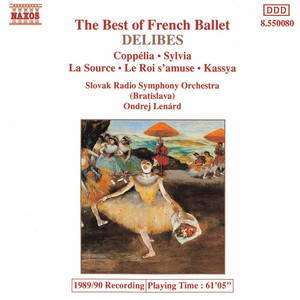 | Le roi s'amuse: Pavane | Léo Delibes, Slovak Philharmonic, Ondrej Lenard | B♭ Major | 0 | 6B | 91 BPM | |
| Zoroastre, RCT 62, Acte III, Scène VII: Gavotte en rondeau | Jean-Philippe Rameau, Teodor Currentzis | A♭ Minor | 1 | 1A | 116 BPM | |
 | Trio Sonata No. 4 in C Major, DürG 13 (Attrib. J.S. Bach as BWV 1037): I. Adagio | Johann Gottlieb Goldberg, London Baroque | D Major | 0 | 10B | 87 BPM | |
 | Sonata in C Minor, Jung III.2.B: I. Largo | Johann Georg Pisendel, Concerto Köln, Mayumi Hirasaki | B Minor | 1 | 10A | 96 BPM |
- ISRC
- USBC19900702
- Label
- L-M Records/RCA Records