- BPM
- 105
- Key
- B♭ Major
- Camelot
- 6B
Quatuor No. 4 in B Minor: III. Gai by Christophe Rousset, Masahiro Arita, Ryo Terakado, Kaori Uemura Song Details
Christophe Rousset, Masahiro Arita, Ryo Terakado, Kaori Uemura's ' "Quatuor No. 4 in B Minor: III. Gai" was released on its scheduled release date, January 1, 2010. With This song being less than two minutes long, at 1:48, we are fairly confident that this song is not explicit and is safe for all ages. Based on the duration of this song, this song duration is much smaller than the average song duration. There are a total of 37 in the song's album "Telemann: Quatuors Parisiens". In this album, this song's track order is #3. In terms of popularity, Quatuor No. 4 in B Minor: III. Gai is currently below average in popularity. Since there is more of a neutral sound being played, this makes the track somewhat danceable.
BPM and Tempo
With Quatuor No. 4 in B Minor: III. Gai by Christophe Rousset, Masahiro Arita, Ryo Terakado, Kaori Uemura having a BPM of 105 with a half-time of 52 BPM and a double-time of 210 BPM, we would consider this track to have a Andante (at a walking pace) tempo marking. Because of this, we believe that the song has an overall slow tempo. The time signature for this track is 4/4.
Music Key
B♭ Major is the music key of this track. Or for those who are familiar with the camelot wheel, this song has a camelot key of 6B. So, the perfect camelot match for 6B would be either 6B or 7A. While, 7B can give you a low energy boost. For moderate energy boost, you would use 3B and a high energy boost can either be 8B or 1B. Though, if you want a low energy drop, you should looking for songs with either a camelot key of 6A or 5B will give you a low energy drop, 9B would be a moderate one, and 4B or 11B would be a high energy drop. Lastly, 3A allows you to change the mood.
Want to find the BPM and music key for other songs? Check out our BPM and Key Finder page!
- Popularity
- 24%
- Loudness
- -21.734 dB
- Acousticness
- 90%
- Danceability
- 48%
- Energy
- 10%
- Instrumentalness
- 0%
- Liveness
- 40%
- Loudness
- 64%
- Speechiness
- 5%
- Valence
- 57%
Recommendations
| Track | Artist | Key | Energy | Camelot | BPM | ||
|---|---|---|---|---|---|---|---|
 | Concerto grosso No. 1 in A Major: I. Adagio (After D. Scarlatti) | Charles Avison, Avison Ensemble, Pavlo Beznosiuk | A♭ Major | 1 | 4B | 81 BPM | |
 | Mozart: Divertimento in F Major, K. 138 "Salzburg Symphony No. 3": III. Presto | Wolfgang Amadeus Mozart, Amsterdam Baroque Orchestra, Ton Koopman | E Major | 1 | 12B | 135 BPM | |
 | Concerto in G Minor: II. Largo | Johann Friedrich Fasch, Combattimento Consort Amsterdam, Han De Vries | B♭ Major | 1 | 6B | 137 BPM | |
 | Oboe Concerto in A Major (arr. J. Barbirolli): III. Sarabanda | Arcangelo Corelli, Anthony Camden, City of London Sinfonia, Nicholas Ward | D Minor | 0 | 7A | 98 BPM | |
 | Concerto a cinque No. 11, Op. 9: II. Adagio | Tomaso Albinoni, Paul Dombrecht, Il Fondamento | F♯ Minor | 2 | 11A | 65 BPM | |
 | Concerto No 5 in G minor - Allegro | Giuseppe Torelli, Charivari Agréable, Kah-Ming Ng | F♯ Minor | 3 | 11A | 140 BPM | |
 | Musique de table, Pt. II, Trio in E Minor, TWV 42:E2: III. Dolce | Georg Philipp Telemann, Orchestra of the Golden Age | D Major | 3 | 10B | 115 BPM | |
 | Introduttione II in F Major, Op. 4 No. 2: II. Andante | Pietro Locatelli, Fabio Biondi, Europa Galante | A♭ Major | 1 | 4B | 123 BPM | |
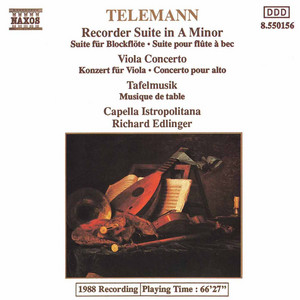 | Overture (Suite) In A Minor, TWV 55:a2: V. Rejouissance | Jiří Stivín, Capella Istropolitana, Georg Philipp Telemann | E Minor | 1 | 9A | 123 BPM | |
 | Concerto Armonico No. 1 in G Major: Un poco andante | Unico Wilhelm van Wassenaer, Aradia Ensemble, Kevin Mallon | E♭ Minor | 1 | 2A | 103 BPM | |
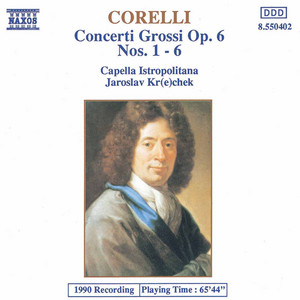 | Concerto Grosso In F Major, Op. 6, No. 6 : III. Largo | Arcangelo Corelli, Quido Holbling, Daniela Ruso, Ludovit Kanta, Anna Holbling, Capella Istropolitana | D Minor | 1 | 7A | 55 BPM | |
 | Concerto for Violin and Bassoon in G Minor: II. Grave | Giuseppe Antonio Brescianello, David Plantier, Eckhard Lenzin, La Cetra Barockorchester Basel, Vaclav Luks | A♭ Major | 2 | 4B | 131 BPM | |
 | Overture (Suite) In C Major, TWV 55: C6: I. Ouverture: Grave. Allegro. Grave | Cologne Chamber Orchestra, Georg Philipp Telemann | G Major | 3 | 9B | 116 BPM | |
 | Symphony No. 1 in B-Flat Major, Op. 2: II. Moderato e dolce | William Boyce, Aradia Ensemble, Kevin Mallon | D♭ Major | 1 | 3B | 131 BPM | |
 | Concerto Grosso in D Major, Op. 1, No. 5: III. Largo | Pietro Locatelli, Capella Istropolitana, Jaroslav Krcek | G Major | 1 | 9B | 144 BPM | |
 | Symphony in C Major, J-C 4: II. Andante e affettuoso | Giovanni Battista Sammartini, Aradia Ensemble, Kevin Mallon | F♯ Major | 1 | 2B | 137 BPM | |
 | Concerto No. 2 for Trumpet, 2 Oboes, Strings and Continuo in D: 4. Vivace | Georg Philipp Telemann, Håkan Hardenberger, Celia Nicklin, Tess Miller, John Constable, Academy of St. Martin in the Fields, Iona Brown | D Major | 2 | 10B | 117 BPM | |
 | Chacony in G | John Blow, Musica Antiqua Köln, Reinhard Goebel | F♯ Major | 2 | 2B | 120 BPM | |
 | Flute Concerto No. 2 in C Minor: I. Prelude - Lentement | Michel Pignolet de Montéclair, Barthold Kuijken, Wieland Kuijken, Robert Kohnen | D♭ Major | 0 | 3B | 69 BPM | |
 | Concerto Grosso in C Minor, Op. 2, No. 2: III. Adagio | Francesco Geminiani, Capella Istropolitana, Jaroslav Krcek | C Minor | 1 | 5A | 57 BPM | |
 | Les Boréades, RCT 31: Entrée de Polymnie (Arr. for Baroque Ensemble & Saxophone by Bo Wiget) | Jean-Philippe Rameau, Lautten Compagney, Asya Fateyeva, Wolfgang Katschner | F Major | 1 | 7B | 101 BPM | |
 | Concerto Grosso in C Minor, Op. 3, No. 11: III. Allegro | Francesco Onofrio Manfredini, Capella Istropolitana, Jaroslav Krcek | C Minor | 1 | 5A | 120 BPM | |
 | Concerto 1 in D Minor, Op. 7: III. Vivace | Jean-Marie Leclair, Luis Otavio Santos, Les Muffatti, Peter Van Heyghen | D♭ Minor | 2 | 12A | 142 BPM | |
 | Concerto for Violoncello, Strings and Basso Continuo in A Minor, RV 418: I. Allegro | Antonio Vivaldi, Anner Bylsma, Tafelmusik Baroque Orchestra, Jeanne Lamon | E Major | 2 | 12B | 135 BPM | |
 | Symphony No. 69 in A Major: I. Allegro | Franz Xaver Richter, Helsinki Baroque Orchestra, Aapo Häkkinen | A♭ Major | 2 | 4B | 117 BPM |
- ISRC
- This song does not have an ISRC.
- Label
- L-M Records/RCA Records