- BPM
- 107
- Key
- B♭ Minor
- Camelot
- 3A
Mathis Der Maler, 1st Tableau, Scene 1: Rector potens, verax Deus (Brüder/Mathis) by Paul Hindemith, Rafael Kubelik, Bayerischer Rundfunk, Bavarian Radio Symphony Orchestra Song Details
"Mathis Der Maler, 1st Tableau, Scene 1: Rector potens, verax Deus (Brüder/Mathis)" by Paul Hindemith, Rafael Kubelik, Bayerischer Rundfunk, Bavarian Radio Symphony Orchestra had its release date on April 1, 1995. The duration of This song is about two minutes long, specifically at 2:05. This song does not appear to have any foul language. Mathis Der Maler, 1st Tableau, Scene 1: Rector potens, verax Deus (Brüder/Mathis)'s duration is considered a little bit shorter than the average duration of a typical track. The track order of this song in Paul Hindemith, Rafael Kubelik's "Hindemith: Mathis der Maler" album is number 3 out of 61. In terms of popularity, Mathis Der Maler, 1st Tableau, Scene 1: Rector potens, verax Deus (Brüder/Mathis) is currently not that popular. In our opinion, the overall tone is not very danceable and projects negative sounds, such as being sad, depressed, or angry.
BPM and Tempo
We consider the tempo marking of Mathis Der Maler, 1st Tableau, Scene 1: Rector potens, verax Deus (Brüder/Mathis) by Paul Hindemith, Rafael Kubelik, Bayerischer Rundfunk, Bavarian Radio Symphony Orchestra to be Andante (at a walking pace) because the track has a tempo of 107 BPM, a half-time of 54BPM, and a double-time of 214 BPM. Based on that, the speed of the song's tempo is slow. The time signature for this track is 3/4.
Music Key
This song has a musical key of B♭ Minor. Because this track belongs in the B♭ Minor key, the camelot key is 3A. So, the perfect camelot match for 3A would be either 3A or 2B. While, a low energy boost can consist of either 3B or 4A. For moderate energy boost, you would use 12A and a high energy boost can either be 5A or 10A. However, if you are looking for a low energy drop, finding a song with a camelot key of 2A would be a great choice. Where 6A would give you a moderate drop, and 1A or 8A would be a high energy drop. Lastly, 6B allows you to change the mood.
Want to find the BPM and music key for other songs? Check out our BPM and Key Finder page!
- Popularity
- 3%
- Loudness
- -32.712 dB
- Acousticness
- 95%
- Danceability
- 23%
- Energy
- 5%
- Instrumentalness
- 0%
- Liveness
- 12%
- Loudness
- 45%
- Speechiness
- 5%
- Valence
- 12%
Recommendations
| Track | Artist | Key | Energy | Camelot | BPM | ||
|---|---|---|---|---|---|---|---|
 | Adagio (Elegy) For String Quartet - Live | Dmitri Shostakovich, Emerson String Quartet | F♯ Minor | 0 | 11A | 90 BPM | |
 | Suite, Op. 157b: I. Ouverture | Darius Milhaud, Jean-Marc Fessard, Frédéric Pélassy, Eliane Reyes | D♭ Major | 0 | 3B | 66 BPM | |
 | Marchenbilder (Fairy Tales), Op. 113: III. Rasch | Robert Schumann, Tabea Zimmermann, Hartmut Höll | F Major | 1 | 7B | 82 BPM | |
 | Violin Sonata, Op. 31, No. 2, "Es ist so schönes Wetter draussen": IV. 5 Variationen uber deas lied "Komm, lieber Mai" | Paul Hindemith, Frank Peter Zimmermann | E Minor | 1 | 9A | 101 BPM | |
 | No. 2, Tempo di minuetto. Grazioso | Antonín Dvořák, Scharoun Ensemble | G Major | 1 | 9B | 81 BPM | |
 | Sextet for Wind Quintet & Piano, FP 100: II. Divertissement: Andantino | Francis Poulenc, Philippe Bernold, Olivier Doise, Ronald Van Spaendonck, Laurent Lefèvre, Hervé Joulain, Alexandre Tharaud | D Major | 1 | 10B | 72 BPM | |
 | Suk: Serenade for Strings in E-Flat Major, Op. 6: IV. Allegro giocoso ma non troppo presto | Josef Suk, Christopher Warren-Green, Andrew Shulman, Lyn Fletcher, Roger Chase, Nigel Warren-Green, London Chamber Orchestra | B♭ Major | 2 | 6B | 106 BPM | |
 | Lutosławski: Concerto for Orchestra: I. Intrada. Allegro maestoso | Witold Lutosławski, Daniel Barenboim, Chicago Symphony Orchestra | F♯ Minor | 1 | 11A | 128 BPM | |
 | Piano Quartet in E-Flat Major, Op. 47: III. Andante cantabile | Robert Schumann, Alexander Melnikov, Jerusalem Quartet | B♭ Major | 0 | 6B | 74 BPM | |
 | Symphony No. 2 in D Major, Op. 43: III. Vivacissimo | Jean Sibelius, Oslo Philharmonic Orchestra, Klaus Mäkelä | F♯ Minor | 1 | 11A | 66 BPM | |
 | String Quintet in G Major, FS 5: II. Adagio | Carl Nielsen, Tim Frederiksen, Danish String Quartet | B♭ Major | 1 | 6B | 80 BPM | |
 | Ein Heldenleben, Op. 40, TrV. 190: Des Helden Friedenswerke | Richard Strauss, Wiener Philharmoniker, Christian Thielemann, Rainer Honeck | D Major | 1 | 10B | 56 BPM | |
 | Heut triumphieret Gottes Sohn, BWV 630 (Arr. for Orchestra by Sir Andrew Davis) | Johann Sebastian Bach, Martyn Brabbins, BBC Philharmonic | E♭ Major | 0 | 5B | 73 BPM | |
 | Viola Sonata, Op. 11, No. 5: III. Scherzo. Schnell | Paul Hindemith, Nobuko Imai | F♯ Major | 1 | 2B | 71 BPM | |
 | Petit Quatour pour Saxophones - Arr. Rainer Schottstadt: 2. Cantilène | Jean Françaix, The Clarinotts | F Minor | 0 | 4A | 134 BPM | |
 | Lieder ohne Worte, Op. 67: No. 4 Presto "Spinnerlied" (Arr. Ottensamer for Clarinet and Strings) | Felix Mendelssohn, Andreas Ottensamer, Schumann Quartett, Gunars Upatnieks | C Major | 3 | 8B | 159 BPM | |
 | Nocturne No. 8 in A Major, H. 46 | John Field, Michael Collins, Michael McHale | E Minor | 0 | 9A | 72 BPM | |
 | Violin Sonata No. 1, Op. 31: V. Prestissimo | Paul Hindemith, Herwig Zack | G Minor | 1 | 6A | 81 BPM | |
 | Ethereal Reverie | Sebastian Verneau | D Major | 3 | 10B | 153 BPM | |
 | Concerto for Viola and Orchestra: I. Andante comodo | William Walton, Edward Gardner, BBC Symphony Orchestra, James Ehnes | A Minor | 1 | 8A | 103 BPM | |
 | Violin Concerto, Op. 36: 2. Andante grazioso | Arnold Schoenberg, Hilary Hahn, Swedish Radio Symphony Orchestra, Esa-Pekka Salonen | D Minor | 1 | 7A | 103 BPM | |
 | Symphony No. 2 in One Movement, Op. 30: III. Andante | Ruth Gipps, Rumon Gamba, BBC National Orchestra Of Wales | F♯ Minor | 0 | 11A | 64 BPM | |
 | Concerto For Oboe And Strings: 2. Minuet & Musette | Ralph Vaughan Williams, Neil Black, English Chamber Orchestra, Daniel Barenboim | G Minor | 2 | 6A | 88 BPM | |
 | Piano Quartet No. 2 in G Minor, Op. 45: III. Adagio non troppo | Gabriel Fauré, Trio Wanderer, Antoine Tamestit | B♭ Major | 2 | 6B | 104 BPM | |
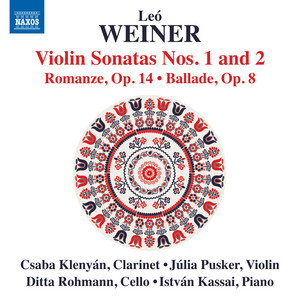 | Romanze, Op. 14 | Leó Weiner, Ditta Rohmann, Istvan Kassai | A♭ Major | 0 | 4B | 133 BPM |
- ISRC
- This song does not have an ISRC.
- Label
- L-M Records/RCA Records