- BPM
- 47
- Key
- F Minor
- Camelot
- 4A
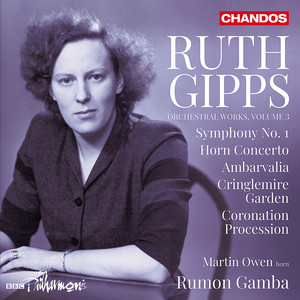
Symphony No. 1 in F Minor, Op. 22: IV. Adagio by Ruth Gipps, BBC Philharmonic, Rumon Gamba Song Details
"Symphony No. 1 in F Minor, Op. 22: IV. Adagio" by Ruth Gipps, BBC Philharmonic, Rumon Gamba had its release date on January 3, 2025. This song appears to be safe for all ages as it is not explicit. The track order of this song in Ruth Gipps, Martin Owen, BBC Philharmonic, Rumon Gamba's "Gipps: Orchestral Works Vol. 3" album is number 10 out of 10. On top of that, United Kingdom appears to be the country where this track was created. Symphony No. 1 in F Minor, Op. 22: IV. Adagio is not that popular right now. In our opinion, the overall tone is not very danceable and projects negative sounds, such as being sad, depressed, or angry.
BPM and Tempo
We consider the tempo marking of Symphony No. 1 in F Minor, Op. 22: IV. Adagio by Ruth Gipps, BBC Philharmonic, Rumon Gamba to be Lento (slowly) because the track has a tempo of 47 BPM, a half-time of 24BPM, and a double-time of 94 BPM. Based on that, the speed of the song's tempo is slow. The time signature for this track is 4/4.
Music Key
This song has a musical key of F Minor. Because this track belongs in the F Minor key, the camelot key is 4A. So, the perfect camelot match for 4A would be either 4A or 3B. While, a low energy boost can consist of either 4B or 5A. For moderate energy boost, you would use 1A and a high energy boost can either be 6A or 11A. However, if you are looking for a low energy drop, finding a song with a camelot key of 3A would be a great choice. Where 7A would give you a moderate drop, and 2A or 9A would be a high energy drop. Lastly, 7B allows you to change the mood.
Want to find the BPM and music key for other songs? Check out our BPM and Key Finder page!
- Popularity
- 3%
- Loudness
- -24.229 dB
- Acousticness
- 92%
- Danceability
- 9%
- Energy
- 2%
- Instrumentalness
- 85%
- Liveness
- 9%
- Loudness
- 60%
- Speechiness
- 4%
- Valence
- 4%
Recommendations
| Track | Artist | Key | Energy | Camelot | BPM | ||
|---|---|---|---|---|---|---|---|
 | Symphony No. 1 in F Minor, Op. 22: III. Allegro | Ruth Gipps, BBC Philharmonic, Rumon Gamba | F Minor | 0 | 4A | 47 BPM | |
 | Dances in the Canebrakes (Arr. W.G. Still for Orchestra): No. 2, Tropical Noon | Florence Beatrice Price, Chicago Sinfonietta, Mei-Ann Chen | A Major | 1 | 11B | 134 BPM | |
 | Montgomery Variations: I. The Decision – Andante deciso | Margaret Bonds, Philadelphia Orchestra, Yannick Nézet-Séguin | D Minor | 0 | 7A | 141 BPM | |
 | Aria, Op. 9 | Mieczysław Weinberg, Deutsche Kammerphilharmonie Bremen, Mirga Gražinytė-Tyla | B♭ Major | 1 | 6B | 103 BPM | |
 | String Octet in C Major, Op. 7 (Version for String Orchestra): Même temps | George Enescu, Tabea Zimmermann, Ensemble Resonanz | B Major | 0 | 1B | 72 BPM | |
 | Norfolk Rhapsody No. 1 in E minor | Ralph Vaughan Williams, New Queen's Hall Orchestra, Barry Wordsworth | E Minor | 0 | 9A | 80 BPM | |
 | DANCE: III. in the middle of the fighting | Anna Clyne, Inbal Segev, London Philharmonic Orchestra, Marin Alsop | A Minor | 1 | 8A | 82 BPM | |
 | Clarinet Sonata, Op. 45: III. Scherzando | Ruth Gipps, Peter Cigleris, Duncan Honeybourne | D Minor | 0 | 7A | 139 BPM | |
 | Color Field: I. Yellow | Anna Clyne, Baltimore Symphony Orchestra, Marin Alsop | G Major | 1 | 9B | 98 BPM | |
 | Symphony No. 5, Op. 64: II. Andante | Ruth Gipps, BBC Philharmonic, Rumon Gamba | F♯ Minor | 1 | 11A | 81 BPM | |
| Montgomery Variations: VI. Lament – Doloroso | Margaret Bonds, Philadelphia Orchestra, Yannick Nézet-Séguin | G Minor | 1 | 6A | 106 BPM | |
 | The Holy Boy | John Ireland, Richard Hickox, London Symphony Orchestra | G Minor | 0 | 6A | 101 BPM | |
 | Prelude for Cello & Piano | Ernest John Moeran, Gerald Peregrine, Antony Ingham | B Major | 0 | 1B | 111 BPM | |
 | Symphony No. 4, Op. 29 "The Inextinguishable": II. Poco allegretto | Carl Nielsen, Danish National Symphony Orchestra, Fabio Luisi | C Major | 0 | 8B | 77 BPM | |
 | Suite No. 3, P. 172: I. Italiana: Andantino | Ottorino Respighi, RTÉ National Symphony Orchestra | B♭ Major | 1 | 6B | 94 BPM | |
 | The Seasons, Op. 67: II. Scene 1, L'Hiver | Alexander Glazunov, Neeme Järvi, Royal Scottish National Orchestra | A Major | 2 | 11B | 98 BPM | |
 | Le Tombeau de Couperin, M. 68: V. Menuet (Arr. for Oboe and Orchestra by Joachim Schmeißer) | Maurice Ravel, Albrecht Mayer, Bamberg Symphony, Jakub Hrůša | G Major | 0 | 9B | 97 BPM | |
 | Dances: No. 2, Passacaglia | Tõnu Kõrvits, Ksenija Sidorova, Estonian Festival Orchestra, Paavo Järvi | E Minor | 1 | 9A | 64 BPM | |
 | Symphony No. 5 in D Minor, Op. 107, MWV N 15 - "Reformation": IIIa. Andante - Live | Felix Mendelssohn, Chamber Orchestra of Europe, Yannick Nézet-Séguin | G Minor | 0 | 6A | 71 BPM | |
| Folk Tale | Arnold Bax, Gerald Peregrine, Antony Ingham | G Minor | 1 | 6A | 167 BPM | |
 | Variations on a Rococo Theme, Op. 33, TH 57: Var. V: Allegro moderato | Pyotr Ilyich Tchaikovsky, Jean-Guihen Queyras, BBC Symphony Orchestra, Jiří Bělohlávek | A Major | 0 | 11B | 107 BPM | |
 | A Moorside Suite, H. 173: Nocturne | Gustav Holst, Royal Northern Sinfonia, David Lloyd-Jones | B Minor | 0 | 10A | 80 BPM | |
| Horn Concerto, Op. 58: III. Finale | Ruth Gipps, Martin Owen, BBC Philharmonic, Rumon Gamba | F Minor | 0 | 4A | 47 BPM | |
 | Concerto for Horn and Orchestra, Op. 58: II. Scherzo, Allegretto | Ruth Gipps, David Pyatt, Nicholas Braithwaite, London Philharmonic Orchestra | D♭ Minor | 0 | 12A | 74 BPM | |
 | Eine Alpensinfonie: X. Nacht | Richard Strauss, Bernard Haitink, London Symphony Orchestra | B♭ Minor | 0 | 3A | 86 BPM |
- ISRC
- GBLWD2500310
- Label
- L-M Records/RCA Records